
Plate Rolling Machine Types, Working Principle & Buying Guide
A plate rolling machine is a metal forming machine used to bend flat plates into cylindrical, conical, curved, or other shaped workpieces. The right machine depends on more than plate thickness. Material grade, yield strength, working width, required diameter, pre-bending capacity, production volume, and automation level must all be considered.
This guide explains the main types of plate rolling machines, how three-roll and four-roll machines work, and how to select a suitable configuration for your application.
Classification Overview
Rolling machines vary in type depending on their application. Based on the number of rolls, they are classified into three-roll and four-roll rolling machines. Among three-roll rolling machines, there are symmetrical three-roll rolling machines, horizontal-down-adjustable three-roll rolling machines, arc-down-adjustable rolling machines, upper-roll universal three-roll rolling machines, and hydraulic CNC rolling machines. In terms of technological advancement, the universal upper-roll type is the least advanced, the horizontal-lowering type is slightly more advanced, and the arc-lowering type is the most advanced. Three-roll plate rolling machines come in mechanical and hydraulic types; among them, mechanical three-roll plate rolling machines are further divided into symmetrical and asymmetrical types.
Performance Characteristics of the Mechanical Symmetrical Three-Roll Plate Rolling Machine: This machine features a symmetrical three-roll configuration. The upper roll moves vertically up and down in a symmetrical position between the two lower rolls, driven by a lead screw and nut or worm gear mechanism. The two lower rolls rotate, with the output gear of the reducer meshing with the lower roll gears to provide the torque required for rolling the sheet metal. A drawback of this machine is that the ends of the sheet metal must be pre-bent using other equipment.
Main Features of the Three-Roll Mechanical Asymmetric Plate Rolling Machine: This machine features a three-roll asymmetric design. The upper roll serves as the main drive, while the lower roll moves vertically to clamp the sheet metal; it also engages with the upper roll’s gear to function as the main drive. the side rollers perform tilting and lifting movements, serving both pre-bending and rolling functions. The machine features a compact design and is easy to operate and maintain.
Main Features of the Three-Roll Hydraulic Symmetrical Plate Rolling Machine: The upper roll of this machine can move vertically; this vertical movement is achieved through a hydraulic drive, where hydraulic oil within the cylinder acts on the piston rod. The lower roll is driven by rotation via meshing with the output gear of the reducer, providing torque for rolling the sheet metal. The lower roll is equipped with adjustable support rollers at its base. The upper roll is drum-shaped, which improves the straightness of the finished product and is suitable for rolling extra-long tanks of various cross-sectional shapes.
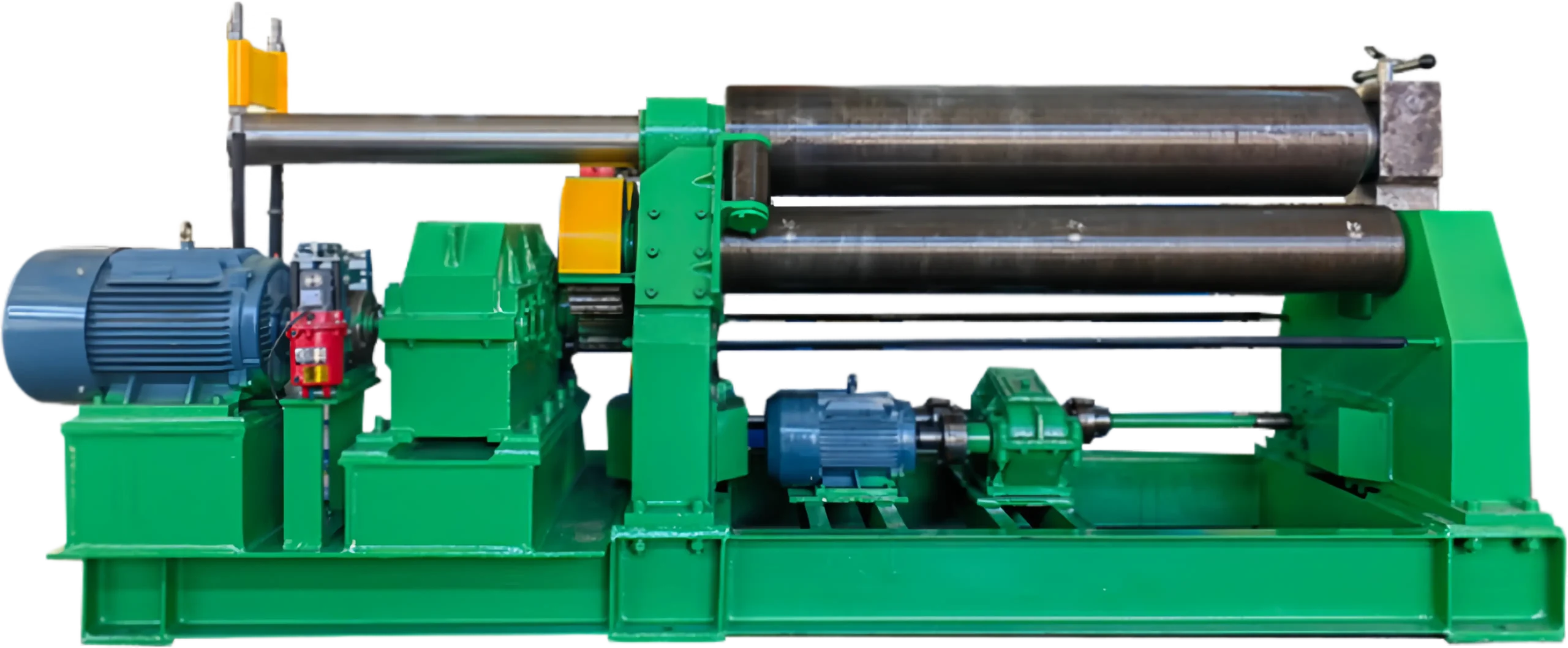
Asymmetric Three-Roll Plate Bender:https://plsoncnc.com/product/three-roller-symmetrical-plate-rolling-machine/
The top-adjustable symmetrical three-roll plate rolling machine can roll metal sheets into circular, arc-shaped, and conical workpieces within a certain range. In this model, the two lower rolls are drive rolls, while the upper roll is a driven roll. It is widely used in the shipbuilding, boiler, aviation, hydropower, chemical, metal structure, and machinery manufacturing industries. Suitable for bending and deforming metal sheets, it can roll circular, arched, and conical workpieces within a certain range, and features a sheet end pre-bending function. In this model, the two lower rollers are driven rollers that can move horizontally, while the upper roller is a driven roller that can move up and down. Movement can be mechanical or hydraulic, and the drive shafts are connected via universal joints.
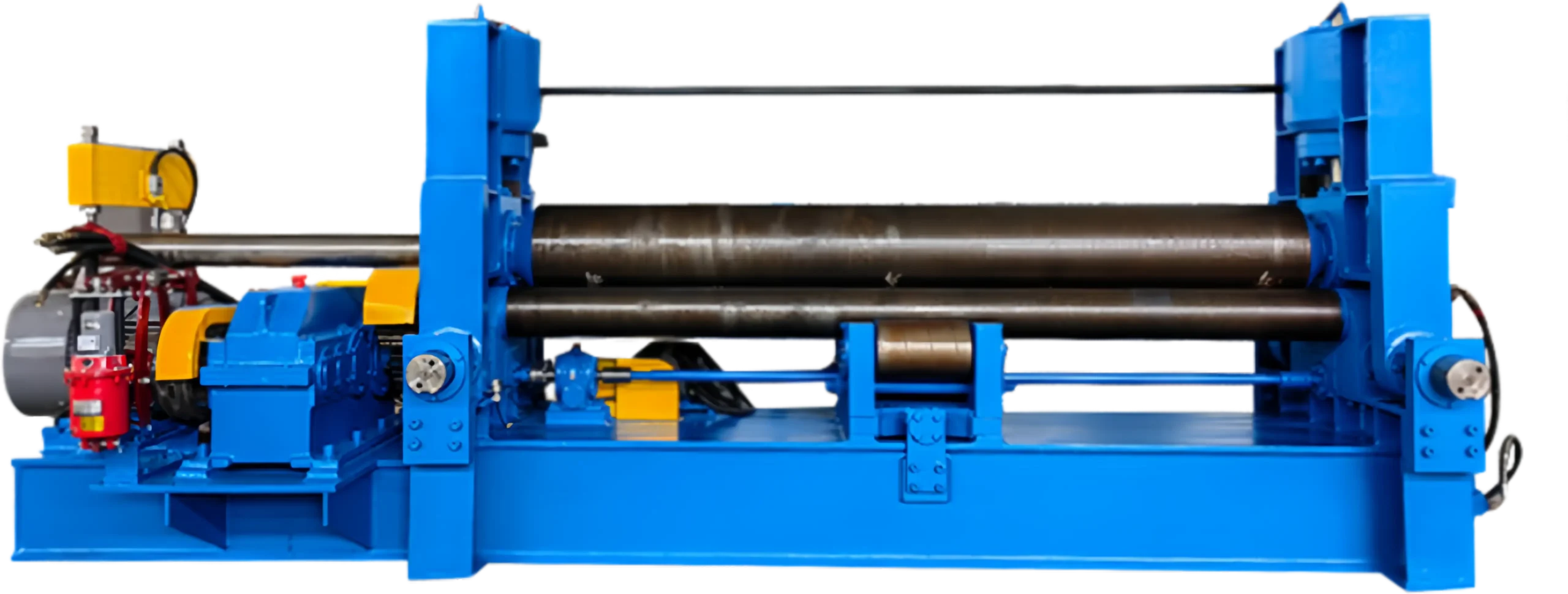
Upper-Roll Universal Three-Roll Plate Bender:https://plsoncnc.com/product/w11s-size-upper-roller-universal-plate-rolling-machine/
Operating Details
The operational efficiency and failure rate of machinery are typically closely related to the operators. As operators of hazardous equipment, they should gain a thorough understanding of relevant knowledge to effectively prevent accidents caused by operator error. Let’s now review the safety requirements for operating a plate rolling machine:
1. First, operators must tidy up the surrounding work area before operation to maintain a safe working environment.
2. Operators must also wear neat and tidy clothing to prevent the edges of their garments from being caught in the rollers during operation.
3. During operation, operators must stand only on either side of the workpiece, as these are the safest and most appropriate positions.
4. Allow for a certain amount of material allowance when finishing the workpiece.
5. If adjustments or measurements of dimensions and roundness are required during operation, the machine must be shut down first; such operations are strictly prohibited while the machine is running.
6. Operators must not stand on a finished cylinder while measuring dimensions or roundness, nor should anyone stand on the workpiece being processed.
7. For workpieces that are difficult to process—such as those that are thick, have a large diameter, or are made of raw materials with high hardness or strength—the desired result should be achieved through multiple passes of minimal material removal.
8. For workpieces with smaller diameters, they should be placed in the center of the rollers for rolling.
Sealing Performance
Whether used by small or large enterprises, or in factories similar to plate rolling machine manufacturers, this type of equipment must be equipped with sealing devices to prevent leaks or the ingress of dust during the machining process.
Sealing components—or seals—in a plate rolling machine’s hydraulic system are materials or parts designed to prevent fluids or solid particles from leaking between adjacent mating surfaces and to prevent external contaminants, such as dust and moisture, from entering the machine’s interior. External leakage of seals in a plate rolling machine’s hydraulic system can result in waste of the working medium, contamination of the machine and the environment, and may even lead to mechanical failure and personal injury.
The reliability and service life of seals in a plate rolling machine’s hydraulic system are key indicators of the system’s performance. With the exception of clearance seals, all other types utilize seals to maintain the gap between two mating surfaces below the minimum clearance through which the fluid to be sealed could pass. In contact-type seals used in the hydraulic systems of plate rolling machines, seals are typically classified into two types: self-sealing compression seals and self-sealing self-tightening seals (also known as lip seals). However, the factors affecting the performance of various seals in plate rolling machine hydraulic systems differ; for example, the seals in a three-roll plate rolling machine are also influenced by temperature, pressure, and the specific working fluid present.
To learn more, follow us on YouTube.