
How to Choose a Laser Cutting Machine: Power, Accuracy, Automation
Laser cutting has become the default process in modern fabrication: high precision, high speed, and a level of flexibility that no mechanical process matches. The difficulty is no longer deciding whether to buy a laser. It is choosing between the hundreds of models on offer, where the specification sheets all look similar and the price differences are large.
The selection problem has a fixed order. Get the order wrong and you either overspend on capability you never use, or buy a machine that cannot cut the work you actually sell. This guide walks through that order.
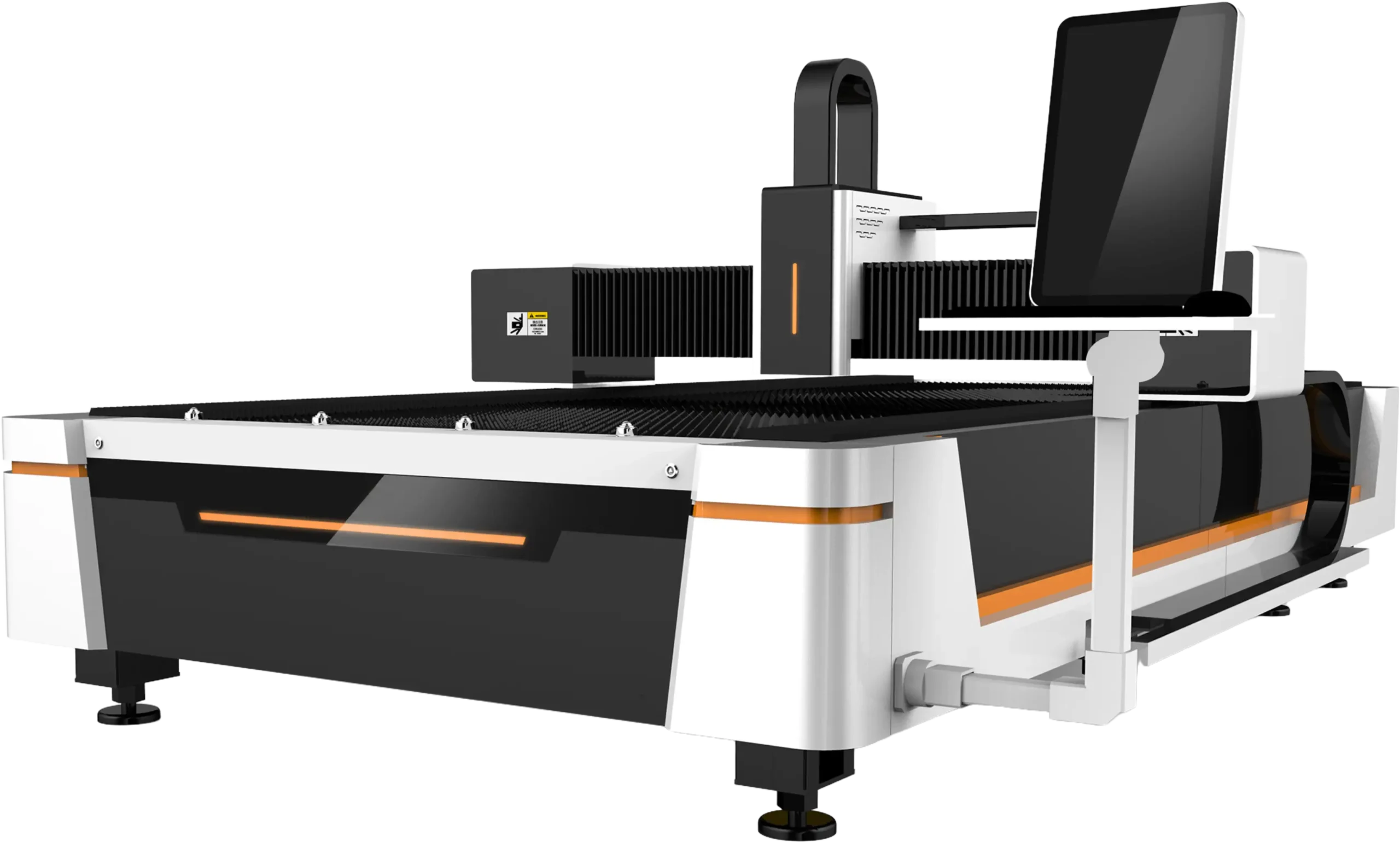
Why laser cutting displaced flame cutting and punching
The mechanical advantage is straightforward: the cutting head never touches the workpiece. Nothing can scratch the surface, no tooling wears, and no force is applied to the sheet.
The consequences show up on the shop floor:
- Narrow kerf, small heat-affected zone. Distortion stays low on thin sheet, so parts do not need flattening after cutting.
- Cuts without a dedicated tool. No punch dies, no blanking tools, no setup time per pattern. The cut path comes from the drawing, so design changes cost nothing at the machine.
- Nesting saves material. Software packs parts onto the sheet automatically; a well-nested sheet typically yields noticeably more parts than manual layout.
- Clean edges. Cut faces are smooth enough that secondary machining is often unnecessary.
- Tight positioning. Positioning and repeat positioning accuracy around 0.03 mm is achievable on production machines, which is why laser competes directly with milling for flat parts.
Compared with flame cutting, the difference is not marginal: narrower kerf, far less heat input, and no need for subsequent edge clean-up.
First decision: metal or non-metal
Before comparing models, decide which material family you are cutting, because the laser source is not interchangeable.
Metal — fiber laser. Fiber sources couple efficiently into steel, stainless, aluminium, copper and brass, run at high electrical efficiency, and have low consumable cost. For sheet metal work, fiber is the mainstream answer and there is little reason to consider anything else.
Non-metal — CO2 laser. Acrylic, wood, fabric, leather, paper, rubber, plastics, stone and ceramics absorb the CO2 wavelength far better than they absorb fiber. For organic materials in particular, CO2 cuts cleaner and cheaper. Thin non-metal work can also be handled by diode sources, with lower throughput and a narrower material range.
Mixed production. If the business cuts both metal and non-metal, the practical answer is usually two machines rather than one compromise. Green and UV sources can address some mixed requirements, but cost and throughput limits mean they are rarely the economical choice for general fabrication.
This is why the first question in any quotation request should be material family, not power.
Matching power to thickness
Power is the single most consequential specification, and the most commonly overspecified. Higher power cuts thicker material faster, but it also raises purchase price, electricity consumption and gas consumption — permanently.
Reference values for fiber laser cutting of carbon steel:
Two caveats matter more than the table.
First, these are carbon steel figures. Stainless steel, aluminium and copper need more power for the same thickness, and reflective or high-conductivity metals need more still.
Second, specify from your routine thickness, not your occasional maximum. If 90% of your work is 2 mm and you cut 12 mm four times a year, a machine sized for 12 mm is idle capability for the other 350 days.
Accuracy: buy what the part requires
Precision has a price curve that steepens quickly. The right question is not “how accurate can it be” but “how accurate does this part have to be, and what does the extra increment cost”.
High-precision work — precision electronics, medical components, jewellery, fine instrumentation — is where the increments are worth paying for. At this level the specification depends on machine structure stiffness, the transmission system (linear motors generally outperform servo plus rack-and-pinion or ball screw for dynamic accuracy), thermal stability of the frame, controller performance, and closed-loop measurement.
General fabrication — enclosures, kitchen equipment, structural brackets, elevator panels, switchgear cabinets — is normally satisfied by ±0.05 mm to ±0.1 mm. A standard configuration from a competent manufacturer meets this without paying for a precision platform.
Spending for precision you do not need is one of the two most common buying errors in this category. The other is buying a machine too light for the thickness range, then discovering that “it can cut 20 mm” means “it can cut 20 mm slowly, with a rough edge, and only when everything is perfect”.
Throughput and automation
Automation is where the real productivity difference sits once the laser source is fixed, because a laser earns money only while it is cutting.
Manual load and unload. Suitable for small batches, high-mix work, or large formats handled by overhead crane. Lowest capital cost, highest idle time.
Exchange tables. While one table cuts, the operator loads or unloads the other. Suppliers typically quote 30–50% throughput improvement. For mid-volume production this is the best value in the category.
Automated load and unload, including FMS storage towers and gantry or robot handling. Built for high volume and long unattended runs — the “lights-out” configuration. High capital cost, but the payback arrives when labour and idle time are the binding constraint.
Choose automation from your daily and monthly volume, then confirm it with a simple calculation: how many hours per day will the laser actually be cutting? If the answer is four, an FMS buys you nothing.
Cut edge requirements
Edge quality is usually the last item discussed and the first one the customer inspects.
Dross and perpendicularity. Smooth, perpendicular faces with minimal dross depend on high beam quality, correct parameters (gas pressure, focus position, speed) and a stable machine. On thick plate, power headroom is what buys a clean face at a usable speed.
Heat-affected zone. Tool steel, carbide and precision parts may need the HAZ minimised. Fiber laser already delivers relatively low heat input; pulsed high-peak-power modes reduce it further, and ultrafast sources go further still at a significant cost step.
Surface protection. For decorative panels and mirror stainless, protection starts with the support structure — honeycomb, brush or bristle tables rather than sharp slats — plus protective film during cutting, nitrogen rather than oxygen where edge chemistry matters, and a handling system that does not drag the sheet.
Specification checklist before you request quotes
Work through this in order. Each answer constrains the next, and suppliers can respond to it precisely.
- Material family — metal, non-metal, or both.
- Thickness range, split into routine and occasional maximum.
- Sheet format and maximum part size.
- Required accuracy, and whether it must hold across a full shift.
- Daily and monthly cutting hours; how much of that can run unattended.
- Automation level — manual, exchange table or FMS.
- Edge quality requirement, including whether parts are visible/anodised/brushed.
- Gas supply — oxygen, nitrogen or compressed air, and the consumption at your duty point.
- Extraction and filtration, plus local emissions requirements.
- Service footprint — who commissions, who trains, and where spares sit.
The short version
Laser source follows the material. Power follows the routine thickness, not the maximum. Accuracy follows the part tolerance, not the brochure. Automation follows the cutting hours per day, not the ambition. Answer those four in that order and the model list collapses to a handful of comparable options — which is the point at which price becomes a meaningful comparison rather than a distraction.
[Talk to a PLSON Engineer →]
📧 Eric@plsonmachine.com
🏭 Haian Industry Park, Jiangsu Province, China