
Three Roll Plate Rolling Machine: Principles, Applications and Technological Innovations
In the modern metalworking sector, plate rolling machines, as key equipment for sheet metal forming, are widely used in industries such as shipbuilding, pressure vessels and energy equipment. Among these, three-roll plate rolling machines have become the equipment of choice for small and medium-sized enterprises due to their simple structure, flexible operation and high cost-effectiveness.
Working Principle and Structure of Three Roll Plate Rolling Machines
A three-roll plate rolling machine consists of three main rollers: two fixed lower rollers and one movable upper roller (or two side rollers in a symmetrical configuration). Its core principle involves the rotation and pressure exerted by the rollers to induce plastic deformation in the metal sheet, thereby forming arched or cylindrical workpieces with the required curvature.
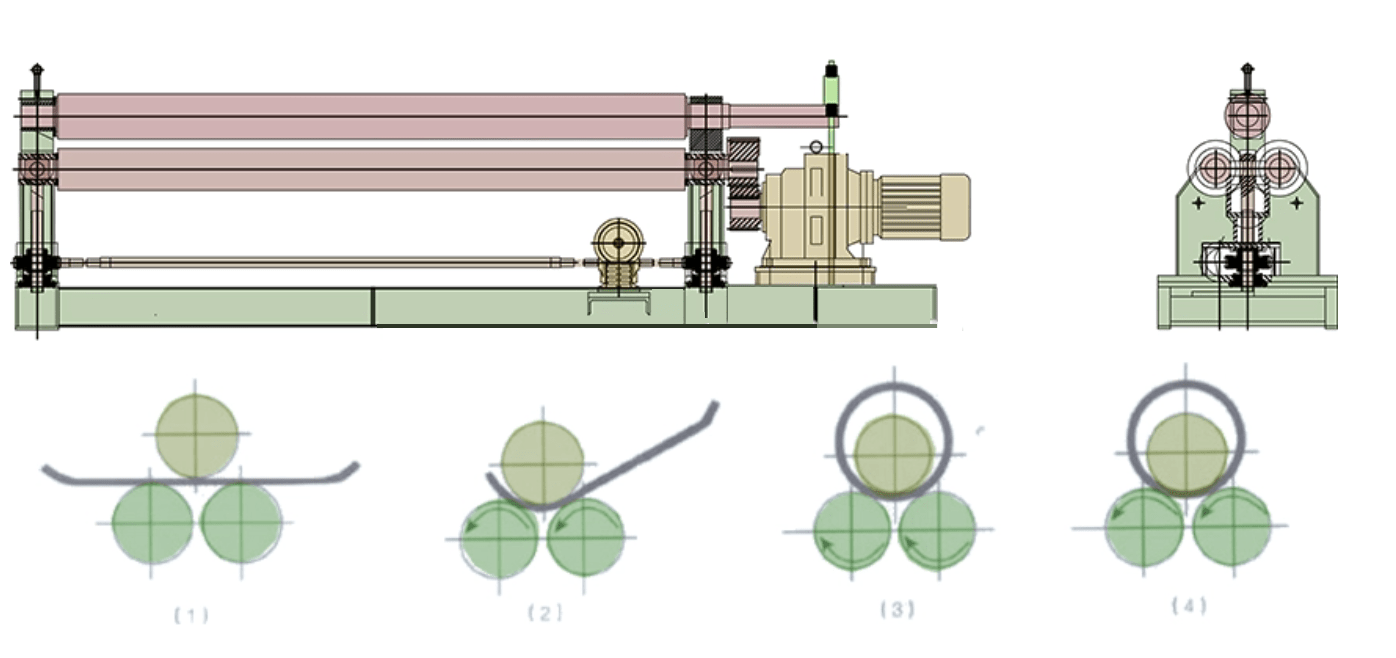
1. Mechanical Transmission and Hydraulic Drive
Symmetrical three-roll plate rolling machine: The upper and lower rolls are arranged symmetrically and rotate synchronously via a mechanical gear drive. During operation, the two ends of the sheet must be pre-bent; this machine is suitable for processing regular arcs.
Asymmetrical three-roll plate rolling machine: The upper roll can be raised and lowered vertically, whilst the lower roll is either fixed or rotates actively; the hydraulic system provides the pressure. Rolling can be carried out directly without the need for pre-bending, significantly improving efficiency.
2. Key Parameters and Performance
Maximum processing thickness: Typically 6,100 mm (depending on the equipment model);
Rolling speed: 0.55 m/min;
Minimum rolled diameter: Depends on the roller diameter and the sheet’s ductility; cold work hardening of the material must be avoided.
Technical Advantages and Limitations
Advantages:
Simple structure and low maintenance costs: Compared to four-roll plate rolling machines, the complex auxiliary roller system is eliminated, resulting in a lower failure rate;
High adaptability: Capable of processing a variety of materials, including carbon steel, stainless steel and aluminium alloys;
Energy-efficient and high-performance: Hydraulic models consume approximately 30% less energy than traditional mechanical models.
Limitations:
Pre-bending requirement: Symmetrical models require an additional process to treat the ends of the plate;
Accuracy limitations: For high-precision cylinders (such as nuclear power plant pressure vessels), secondary processing using circularity correction equipment is required.
Typical Application Scenarios
1. Shipbuilding Industry
Used for processing curved outer plates of ship hulls. Shipyards utilise 30 mm thick steel plates to roll 8-metre-diameter hull sections; three-roll plate rolling machines employ sectional pressure application technology to prevent surface scratches on the plates.
2. Pressure Vessel Production
In the manufacture of liquefied natural gas (LNG) storage tanks, three-roll plate rolling machines, in conjunction with CNC systems, achieve a curvature accuracy of ±0.5 mm, meeting ASME standards.
3. New Energy Equipment
In the rolling of conical sections for wind turbine towers, by adjusting the inclination angle of the upper roll, asymmetrical models can complete forming operations with tapers of 5° to 15° in a single pass.
Technological Innovation and Development Trends
1. Intelligent Upgrades
The introduction of PLC control systems and laser distance metres provides real-time feedback on plate curvature. For example, a smart model launched by a certain brand allows parameters to be preset via an HMI interface, automatically compensating for springback.
2. Composite Processing Capabilities
Integrated equipment combining bevel cutting and rolling functions has entered the market, reducing workpiece turnaround time by up to 40 per cent.
3. Green Manufacturing Technologies
The adoption of silent hydraulic systems and scrap recycling devices reduces noise levels to below 75 dB, whilst enabling the automatic collection and reuse of metal shavings.
4. Breakthroughs in Material Adaptability
For the cold rolling of high-strength steels (such as Q690D), new roller surface coating technologies have been developed to minimise micro-cracks caused by friction.
Model Selection and Usage Recommendations
1. Key Considerations for Model Selection
Select the roller shaft diameter according to sheet thickness (generally, the roller diameter should be ≥20 times the sheet thickness);
For hydraulic models, give priority to closed-loop pressure control systems;
Equip the machine with infrared safety protection devices that comply with the ISO 12100 standard.
2. Operating Guidelines
Clean the roller surfaces before rolling to prevent impurities from being pressed into the sheet;
Apply pressure gradually to prevent roller deformation caused by sudden overloading;
Regularly check the parallelism of the rollers, ensuring the error is kept within 0.1 mm/m.
With the advancement of smart manufacturing and green manufacturing, three-roll plate rolling machines are evolving from traditional mechanical designs towards high-precision, automated systems. In the future, through integration with AI algorithms, these machines may achieve self-learning processing, further driving transformation in the field of metal forming. For enterprises, appropriate equipment selection and technological innovation will be key to enhancing competitiveness.
If you’d like to learn more about the specifications:https://plsoncnc.com/product/three-roller-symmetrical-plate-rolling-machine/
Three-Roll Plate Rolling Machine Video:https://www.youtube.com/watch?v=wUINCrtxfHs