
Press Brake Pressure Adjustment: The Complete Guide to Precision, Optimization & Safety
Introduction
Press brake pressure adjustment sits at the heart of sheet metal fabrication — it directly determines part quality, tooling life, and operator safety. In the plastic deformation of metal sheets, pressure control is like a surgeon’s scalpel: you need enough force to achieve the desired shape, but not so much that you overload the tooling or damage the machine.
What looks like a simple parameter setting is, in reality, a combination of material mechanics, mechanical engineering, and years of process experience. This guide covers the principles, optimization methods, and practical know-how that separate average operators from expert-level fabricators.
1. The Mechanics Behind Pressure Adjustment
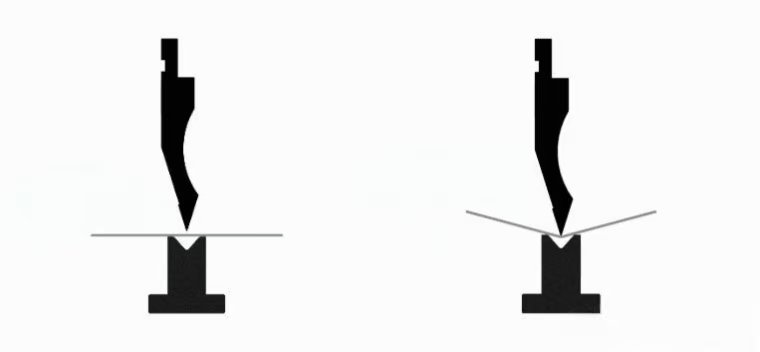
Stress Distribution During Bending
When a metal sheet is bent, it undergoes a complex stress distribution: the outer layer is subjected to tensile stress while the inner layer experiences compressive stress. Plastic deformation begins when the applied pressure reaches 120–150% of the material’s yield strength.
Different materials behave very differently under the same pressure:
Stainless steel’s work hardening effect means that as you bend it, it literally gets harder — demanding more pressure mid-cycle. Aluminum’s low elastic modulus means it springs back far more, so you need to over-bend to compensate.
Tooling Geometry and Pressure: A Non-Linear Relationship
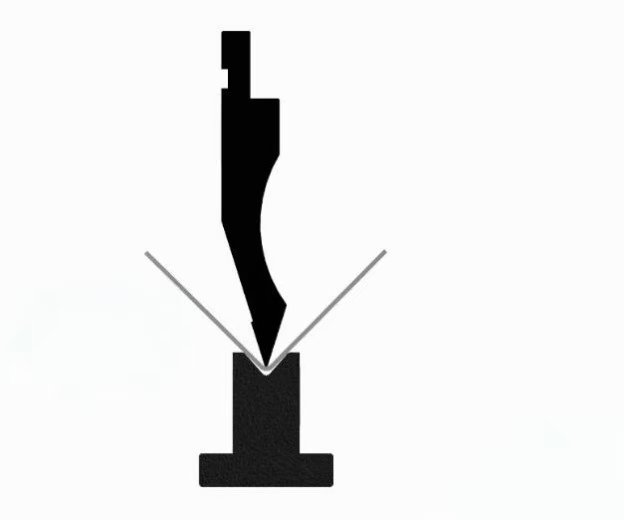
Increasing the V-die opening by 1mm reduces required pressure by 8–12% — a useful adjustment when you’re pushing the machine’s tonnage limit. But the relationship isn’t always intuitive:
- When increasing the punch tip radius from 0.5mm to 3mm, the contact area expands, reducing unit pressure — yet the total force requirement increases by about 15%. This is because the larger contact zone requires more force to overcome the wider distribution of material resistance.
Modern CNC Pressure Control
Today’s CNC press brakes use closed-loop pressure control: a servo motor drives a hydraulic proportional valve, with pressure sensors achieving ±0.5 MPa accuracy. On a 200-ton PLSON press brake, the pressure sensor samples at 1,000 Hz — monitoring pressure fluctuations in real time and auto-compensating to keep bend angle deviations within ±0.5°.
2. Pressure Parameter Optimization
The Limits of Traditional Formulas
The classic formula P = 650 × S² × L / V (where S = thickness, L = length, V = die opening) is no longer sufficient for precision work.
An automotive parts manufacturer developed an improved formula:
P=K×TS×S2×LV×η
Where:
- TS = Material tensile strength (MPa)
- K = Safety factor (1.2–1.5)
- η = Mechanical efficiency (0.85–0.95)
By incorporating these variables, pressure calculation error dropped from 15% to under 5%.
The Principle of Staged Loading
Raw, single-setpoint pressure application is a recipe for springback and inconsistency. The staged loading approach works far better.
Real-world example: A manufacturer bending 3mm 304 stainless steel for electrical enclosures uses three pressure stages:
The outcome: springback reduced by 40%, angle consistency improved to 98.7%.
Smart Testing and Validation
A proper validation workflow has three phases:
- Dry cycle test — Run the machine with no material to confirm pressure reading matches setpoint
- Scrap test bend — Bend a sample piece at 80% of calculated pressure, measure, adjust
- Full-thickness verification — Run at full pressure, measure angle, record parameters
One aerospace fabricator developed an intelligent testing system that automatically captures pressure curves, angle changes, and tooling displacement during test bends. Using machine learning to predict optimal pressure, they cut setup time from 2 hours to 20 minutes.
3. Practical Pressure Control: What Goes Wrong and How to Fix It
Problem: Material Variation Ruining Your Settings
The issue: A batch of SPCC cold-rolled steel arrived at a factory with a yield strength varying by 8% depending on rolling direction. The operator used the same pressure settings, and 10% of parts showed excessive thinning.
The fix:
- Add incoming material inspection to your workflow
- Build a dynamic pressure compensation database: for each material batch and thickness, record the actual pressure that produced the correct angle
- When material changes, check the database first, not the formula
Problem: Hidden Machine Drift
The issue: A 10-year-old hydraulic press brake was producing bends 1.5° off. Investigation revealed the cylinder had developed internal leakage — actual pressure was 12% lower than the displayed value. Hydraulic system efficiency had degraded from 92% to 78%.
The fix:
Problem: Operator Safety During Adjustment
The issue: A factory without a light curtain had a tooling closure accident during pressure adjustment. The operator was adjusting parameters at the controller while a colleague handled the tooling — miscommunication led to an unplanned ram movement.
The fix — mandatory safety rules for pressure adjustment:
- Two-person confirmation: Any pressure adjustment requires both the operator and supervisor to confirm before cycling
- Safe distance during testing: No hands, no measurement tools in the die zone while pressure is active
- Never measure bend angle by hand during cycle — use angle gauges after the ram returns
- Pressure gauge selection: Use shock-resistant gauges with a range of 1.5–2× maximum working pressure
- Light curtains and emergency stops: Must be tested for function before every pressure adjustment session
4. The Future: Adaptive Pressure Control
The industry is moving toward adaptive pressure control. One manufacturer has adopted strain gauge technology embedded in tooling to monitor real-time die loading. Combined with a digital twin system for virtual tryout, their first-part pass rate jumped from 82% to 97%.
What this means for operators:
- Pressure parameters are no longer set once and forgotten — they’re continuously optimized by the machine
- Integration with MES (Manufacturing Execution Systems) allows process data to be tracked per job, per batch
- The operator’s role shifts from “button-pusher” to “process monitor” — understanding the data is now as important as understanding the machine
Quick Reference: Pressure Adjustment Checklist
Key Takeaways
- Know your material — Stainless needs +20-30% more pressure than mild steel; aluminum springs back 2-3× more
- Use staged loading — Contact → Form → Hold reduces springback by up to 40%
- Calibrate regularly — Every 2,000 hours, verify your machine is delivering what the display says
- Build a pressure database — Don’t recalculate from scratch for repeat jobs
- Safety first — Two-person confirmation, light curtains, and proper gauges are non-negotiable
Need help optimizing your press brake pressure settings? PLSON engineers can provide remote guidance or on-site training for your operators — get in touch for a tailored support plan.
[Contact Our Engineers →] 📧 Eric@plsonmachine.com 🏭 Haian Industry Park, Jiangsu Province, China
If you want to watch more YouTube
For more press brakes, click here:https://plsoncnc.com/product-category/press-brake/