
Mechanical Crowning Wedge Worktable in a Servo Torsion Bar CNC Press Brake: Principle, Structure and Accuracy Benefits
Posted by PLSON Engineering Team
Introduction
Modern industrial production depends on bending equipment that is both accurate and efficient. On a servo torsion bar CNC press brake, the worktable is not a passive support surface — its design directly determines the bending accuracy and the quality of the finished part.
This article explains the mechanical crowning wedge deflection compensation worktable used on servo torsion bar CNC press brakes: how the reverse-shape compensation principle works, how the three wedge layers are arranged, and why the system has such a strong effect on bending accuracy.
Technical note: The number of wedge groups, wedge travel, compensation range, and control method vary between machine models and manufacturers. The description below covers the general working principle. Please confirm the actual crowning range, wedge arrangement, and control configuration with the manufacturer or against the machine documentation.
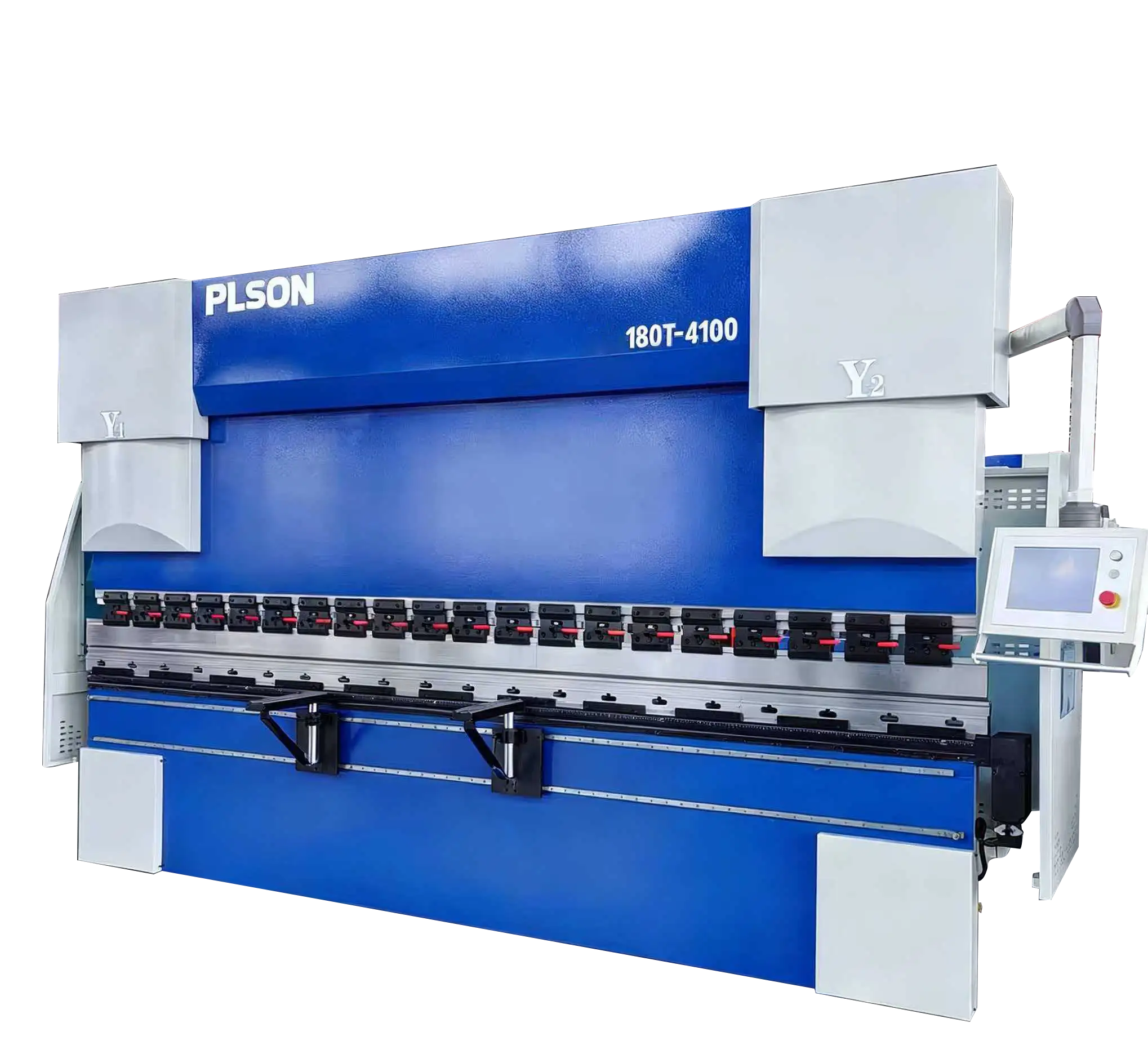
Why Deflection Compensation Is Necessary
When a press brake bends a plate, the ram and the bed are loaded by the bending force. Even a heavily built machine deflects slightly under load. The deflection is greatest at the centre of the machine and approaches zero at the two ends near the side frames.
The practical result is a bending angle that is not uniform along the length of the part:
- The two ends of the workpiece, where deflection is smallest, bend to a tighter angle
- The centre of the workpiece, where deflection is greatest, bends to a more open angle
For short parts this deviation may be acceptable. For long parts, thick plate, or parts with a tight angle tolerance, the difference between the centre and the ends can exceed the drawing tolerance and cause rejected parts, rework, and shim adjustments.
Deflection compensation — commonly called crowning — offsets this error by introducing a controlled, opposite curvature into the worktable so that the bending angle is consistent across the full working length.
1. Basic Principle of Mechanical Crowning Wedge Compensation
The worktable of a servo torsion bar CNC press brake uses a mechanical crowning wedge compensation device. Its core principle is the reverse-shape principle.
Inside the worktable there are several groups of wedges with inclined surfaces. When these crowning wedges move relative to each other, the inclined surfaces slide against one another and the effective height of the worktable changes. Because the wedge groups are arranged along the working length, the worktable can be raised progressively toward the centre, producing a slight convex curve that follows the reversed shape of the machine deflection.
This compensation mechanism controls both the bending angle and the straightness of the workpiece during bending, keeping the bending accuracy within the specified tolerance range.
Key points of the principle:
- Compensation is mechanical, produced by wedge displacement rather than by hydraulic pressure
- The amount of crowning is a function of the relative movement of the wedge pairs
- The resulting curve is a controlled convex shape that mirrors the deflection curve
- Compensation is applied along the working length, so the correction can be graded from the ends toward the centre
2. Structural Features of the Worktable
The wedges inside the worktable are arranged in three layers, and each layer performs a distinct function.
2.1 First Layer: Fixed Wedge (Top Layer)
The fixed wedge forms the base structure of the worktable. It works together with the movable wedge to set the amount of deflection compensation.
Because the fixed wedge provides the reference surface for the whole assembly, its design determines the stability and rigidity of the worktable and gives the crowning system a solid foundation. Any flexing in this layer would be transferred directly to the bending result, so the fixed wedge is designed as a rigid, well-supported component.
2.2 Second Layer: Movable Wedge (Middle Layer)
The movable wedge is the key element of the crowning mechanism. It is adjusted longitudinally through the CNC control system.
As the movable wedges travel, the inclined surfaces change the height of the worktable at each position along its length. The operator or the program sets the crowning value according to the workpiece shape and dimensions, and the worktable is then positioned so that deflection during bending is effectively controlled.
This layer corresponds to motorized mechanical crowning. Because the adjustment is driven by the CNC system rather than by hand, the setting is repeatable, can be stored in the program for each job, and can be changed quickly between different parts.
Typical advantages:
- Crowning value can be set from the control and stored with the program
- Adjustment is repeatable between batches
- No manual intervention inside the machine is required between jobs
- Setting time is short when changing between different part lengths and thicknesses
2.3 Third Layer: Adjusting Wedge (Bottom Layer)
The adjusting wedge sits at the bottom of the worktable and provides manual transverse local adjustment.
When a specific zone of the worktable needs fine correction — for example when the material thickness varies slightly along the sheet, when the workpiece is short and sits at one side of the machine, or when a particular section needs a slightly different result — the operator can adjust the wedges by hand to achieve precise control.
This layer corresponds to manual, handwheel mechanical crowning. It is flexible and practical, and it gives the operator additional adjustment options that a purely automatic system cannot cover.
3. How Mechanical Crowning Improves Bending Accuracy
The mechanical crowning device plays a significant role in improving the bending accuracy of a servo torsion bar CNC press brake.
First, it maintains angle and straightness. Through accurate deflection compensation, the workpiece keeps a stable bending angle and straightness along its length during the bending process, which helps avoid deformation and twisting in the finished part.
Second, it makes adjustment faster and more precise. The CNC control system allows the worktable to be set quickly and accurately, which reduces setup time and improves production efficiency, especially when switching between different part lengths and thicknesses.
Third, it leaves room for fine correction. The manual adjusting wedge allows the operator to make small corrections based on the actual condition of the material and the part, which further protects the bending quality of the workpiece.
Taken together, these three effects reduce angle deviation along the part length, reduce the need for shimming and manual rework, and improve consistency across a production batch.
4. Practical Notes for Operation and Maintenance
To keep the crowning system working as designed:
- Confirm the crowning value is set correctly for the plate length and thickness before running the job.
- Keep the wedge contact surfaces clean. Chips, dust, and hardened grease increase friction and reduce adjustment accuracy.
- Lubricate the wedge sliding surfaces according to the manufacturer’s schedule.
- Do not exceed the rated crowning range of the machine, and do not use crowning to compensate for incorrect tooling or a worn machine.
- Check the machine after any repair that affects the bed or ram, since the crowning setting may need to be re-verified.
- Store crowning values in the control program for repeat jobs to keep results consistent between batches.
- Confirm the correct procedure with the machine documentation before adjusting the manual wedges, and stop the machine before working in the worktable area.
5. Summary
On a servo torsion bar CNC press brake, the mechanical crowning wedge worktable uses the reverse-shape principle to compensate for machine deflection. Several groups of inclined wedges move relative to each other so that the worktable follows a controlled convex curve, keeping bending angle and straightness within tolerance along the full length of the workpiece.
The three-layer structure separates the functions clearly:
- The fixed wedge provides rigidity and the reference surface
- The movable wedge performs motorized, CNC-controlled longitudinal crowning
- The adjusting wedge provides manual transverse fine adjustment
Together they let the machine correct deflection automatically for normal production and still allow precise manual correction when a specific part requires it. The result is a more accurate bend along the full part length, shorter setup time, and more consistent batch quality.
If you need help selecting a servo torsion bar CNC press brake, confirming the crowning range for your plate sizes, or troubleshooting a bending accuracy problem, contact the PLSON engineering team with your plate thickness, length, material, and target bending angle.
Contact the PLSON Engineering Team for press brake selection, crowning configuration, and technical support.
[Contact PLSON Engineers →]
📧 Eric@plsonmachine.com
🏭 Haian Industry Park, Jiangsu Province, China