
Plate Rolling Machine Off-Tracking: Causes, Fixes and Prevention
Posted by PLSON Engineering Team
Introduction
Plate rolling machines are essential equipment in industrial production. They are widely used to roll metal plate into cylindrical shells, cones, and curved sections for tanks, pressure vessels, ducts, and structural work.
When a plate rolling machine off-tracks — when the plate drifts or “walks” to one side instead of rolling straight — the consequences reach further than most operators expect. Efficiency drops, product quality drops, and in serious cases the machine becomes a safety hazard.
So what actually causes off-tracking? The surprising part is how often the root cause turns out to be a small detail rather than a major mechanical failure. This article explains how the machine works, what off-tracking actually is, the causes in the order they are usually found, and how to prevent them.
Safety first: Off-tracking means the plate is moving sideways under load, and a plate that shifts suddenly can swing out or be released from the rolls. Never stand in the path of the plate ends, and never reach into the rolls or the tooling area while the machine is running. Before inspecting rolls, transmission components, or the plate position with the machine stopped, isolate the main power and confirm the rolls cannot rotate or move under load. Only trained and authorized personnel should adjust the rolls or service the transmission.
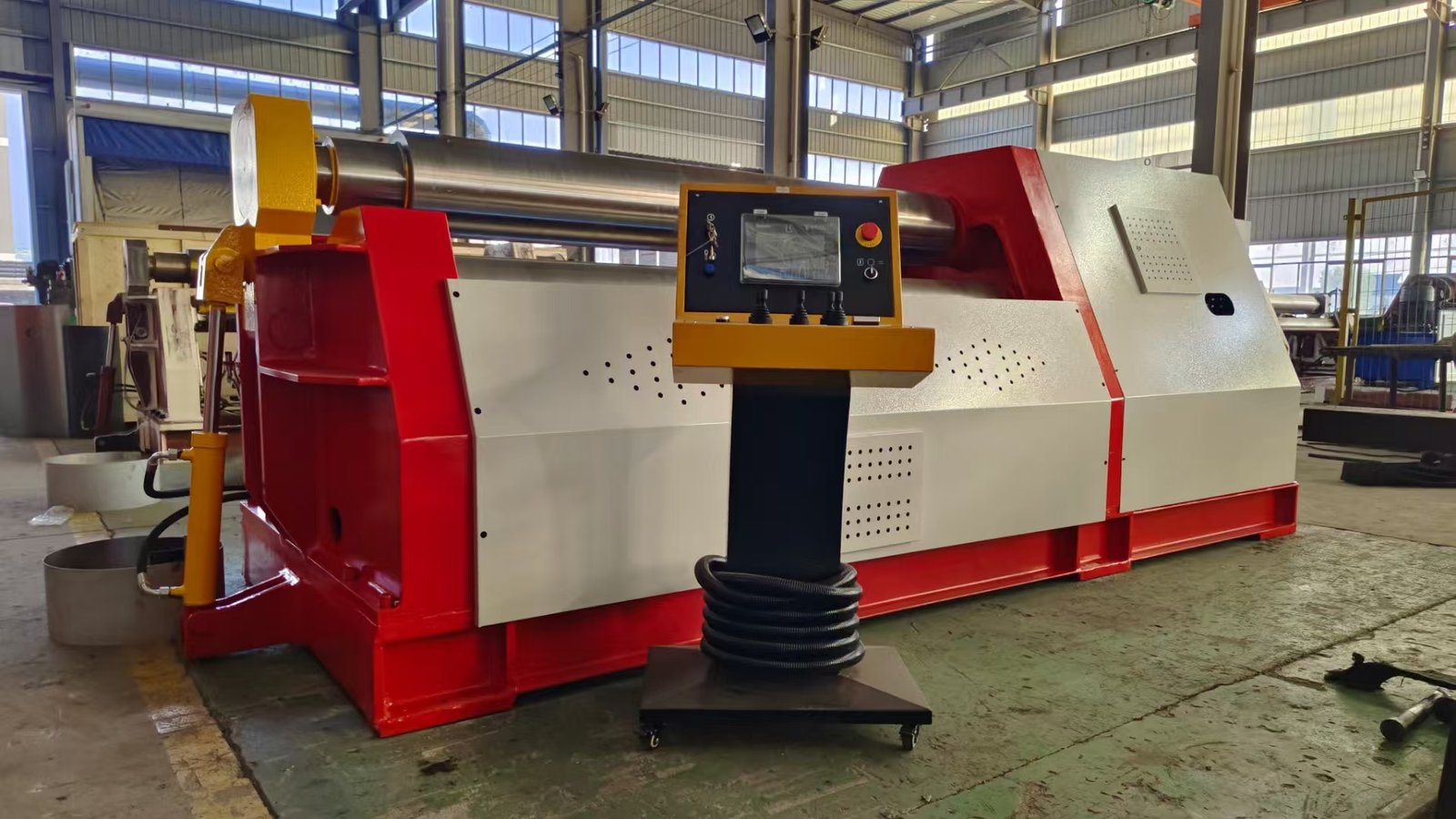
How a Plate Rolling Machine Works
Understanding the mechanism is what makes the causes obvious.
The machine rotates its work rolls through a transmission mechanism — a motor driving a gearbox, couplings, and the shafts that carry the rolls. The plate is gripped between the rolls and driven forward by the friction between the roll surfaces and the plate. As the plate passes through, the bending imposed by the roll arrangement curves it progressively, until a pass or a series of passes brings the plate to the required radius.
The rolls are the upper roll, the lower roll, and the side rolls. A three roll machine has one upper roll and two lower rolls; a four roll plate rolling machine adds a second side roll and provides additional control over the bending and the pre-bending of the plate ends.
For a plate to roll straight, three conditions must hold at the same time.
Every cause in this article works by breaking one of those three conditions. That is the whole diagnostic logic in one sentence.
Why Off-Tracking Matters
Off-tracking is often treated as an inconvenience that the operator can “steer” by hand. It is not — the cost runs across quality, throughput, and safety.
For a workshop producing pressure vessels or pipe sections, the welding cost of a shell with offset edges is usually far higher than the time saved by not fixing the off-tracking problem.
Cause 1: Plate Placement — the Detail Most Often Overlooked
In practice, a large share of off-tracking problems trace back to a small detail: where and how the plate is placed.
If the plate is not sitting flat and level, its contact with the rolls is uneven. Friction is no longer uniform across the width of the plate or along its length, and the machine pulls the plate toward the side where the contact is better. The effect is small at the start of the pass and large by the end of it, which is exactly why operators often describe the problem as “it suddenly went off near the end”.
How to prevent it
- Inspect the plate before loading it: check flatness, edge squareness, thickness uniformity, and cleanliness.
- Clean both the plate and the roll surfaces. Remove oil, scale, water, and debris — this is the cheapest fix available and it is frequently ignored.
- Use proper supporting, guiding, or centering devices instead of relying on the operator’s eye, so the plate is positioned and held squarely to the rolls.
- Position the plate consistently against the stops, and do not change the reference side between passes.
- Confirm the entry edge is square to the roll axis before starting the pass.
- For long or thin plate, make sure the ends are supported so the plate does not tip as it enters.
Cause 2: Roll Condition and Parallelism
Even with a perfectly prepared plate, the machine cannot roll straight if the rolls themselves are out of condition.
What to do: Measure roll diameter and parallelism against the manufacturer’s specification rather than judging by eye. Check the roll surfaces and clean them. Where rolls are worn taper or of unequal diameter, regrinding or replacement is the correct repair — trying to compensate with roll adjustment only moves the error elsewhere in the process. Confirm the crowning setting suits the plate being processed.
Cause 3: Transmission Mechanism
The transmission is what keeps both sides of the driven rolls in step. If it develops slack or wear, the two ends of a roll no longer rotate together, and the plate is fed unevenly.
What to do: Inspect the transmission for backlash and wear against the specification, and repair or replace worn elements rather than tightening settings to hide them. Note that a transmission problem is load-dependent: it often disappears when the machine runs empty and appears only under rolling load, which is why an empty-machine check is not sufficient evidence that the transmission is fine.
Cause 4: Adjustment and Setting Errors
Some off-tracking is not a failure at all — it is a setting error.
- Side rolls not set symmetrically when they should be, so the bending applied at the two ends is different.
- Roll gap not uniform along the width, which curves one end more than the other.
- Clamping force or bending force too high on one side, which deforms the plate unevenly.
- Synchronization error between the two ends of a roll, so the roll does not stay parallel during the pass.
- Incorrect position or pressure settings for the plate being processed, carried over from a previous job.
What to do: Re-establish the settings from the drawing and the machine specification for the plate actually being processed, rather than adjusting until the part “looks right”. If the machine has position feedback on the roll axes, use the measured values to confirm parallelism rather than relying on the indicator alone. On machines with CNC roll control, recall the stored parameters for the job rather than improvising.
Cause 5: Plate and Material Factors
Some plates resist rolling straight no matter how well the machine is set up.
What to do: Measure the plate at several points rather than trusting the nominal thickness. Where the material itself is the cause, the correction belongs upstream — in plate sourcing and edge preparation — not in the machine settings. Trying to force a bowed plate into a straight shell by adjusting the rolls normally transfers the problem into the finished part.
Cause 6: Working Environment
The working environment affects the machine’s behaviour more than most operators expect, and the mechanisms are concrete rather than vague.
What to do: Keep the machine and its surroundings clean, dry, and within the specified temperature range. Check leveling and foundation condition periodically, especially after any relocation. These are inexpensive measures that are often skipped because their effect is gradual.
Systematic Troubleshooting Sequence
Because the causes interact, work through them in a fixed order rather than adjusting whichever setting is closest to hand.
Two practical points about this sequence. First, steps 2 to 4 address the majority of real cases and cost almost nothing — always exhaust them before touching the machine. Second, if the fault disappears when the machine runs empty and returns under load, the cause is almost certainly in the transmission, the roll support, or the settings, not in the plate.
Prevention
Prevention splits naturally into three stages.
Before rolling
During rolling
Maintenance
What Modern Control Systems Change
Rolling technology has developed, and newer machines address off-tracking in ways older machines could not.
Modern control systems monitor roll position and the synchronization between the two ends of a roll, and raise an alarm when the measured deviation exceeds a limit. This matters because off-tracking is often detectable from the positional data before it is visible to the operator. Centering and guiding devices, where fitted, help hold the plate square at entry. Some machines can also correct roll position from position feedback rather than by manual adjustment.
What these features change is worth stating precisely. They reduce the probability and the severity of off-tracking, and they shorten the time between the problem starting and the problem being noticed — which is often the difference between a small correction and a scrapped shell. They do not remove the need for correct plate preparation, clean roll surfaces, and proper maintenance. A machine with excellent control will still roll a bowed, dirty plate badly.
Conclusion
A plate rolling machine off-tracks because one of three conditions has been broken: the plate did not enter squarely, the friction on the two sides of the plate was not equal, or the rolls were not parallel and consistent along the full width.
The causes range from the transmission, the roll condition, the settings, the material, and the environment — but the one that is most often overlooked, and the cheapest to fix, is the small detail of where and how the plate is placed. Checking and cleaning the plate, centering it squarely, and keeping the roll surfaces clean addresses a large proportion of real cases before any machine adjustment is needed.
Beyond that, the reliable approach is unglamorous: improve the operator’s skill and awareness, inspect and maintain the equipment on a schedule, keep the working environment clean, dry, and at a suitable temperature, and take advantage of what modern control systems can monitor. Together these measures prevent off-tracking rather than correcting it after the shell has come out conical.
If your machine is off-tracking and you have worked through plate preparation and cleaning without success, contact our engineering team with the machine model, the plate size and material, and a photo or short video of the behaviour. We will help you identify whether the cause is in the settings, the rolls, or the transmission.
Contact the PLSON Engineering Team for plate rolling machine specifications, spare parts, and technical support.
[Talk to a PLSON Engineer →]
📧 Eric@plsonmachine.com
🏭 Haian Industry Park, Jiangsu Province, China