
How to Calculate Plate Roll Bending Machine Capacity
Posted by PLSON Engineering Team | Reading time: 10 minutes
Introduction
Plate roll bending machine capacity is not determined by plate thickness alone. The real capacity depends on a combination of material strength, plate thickness, working width, required rolling diameter, roll arrangement, pre-bending requirements, and machine design.
A machine may be able to roll a certain thickness after the plate has been pre-bent, but it may not be able to pre-bend the same thickness. Similarly, a capacity stated for mild steel may not apply to stainless steel or high-strength plate.
This guide explains how to estimate the required capacity, how to read a manufacturer’s capacity chart, and what information to provide when requesting a machine recommendation.
Important engineering note: The formulas in this article are simplified selection models for understanding the relationship between the main variables. Final machine capacity must be confirmed by the manufacturer using the actual material grade, yield strength, plate dimensions, target diameter, rolling method, and safety requirements.
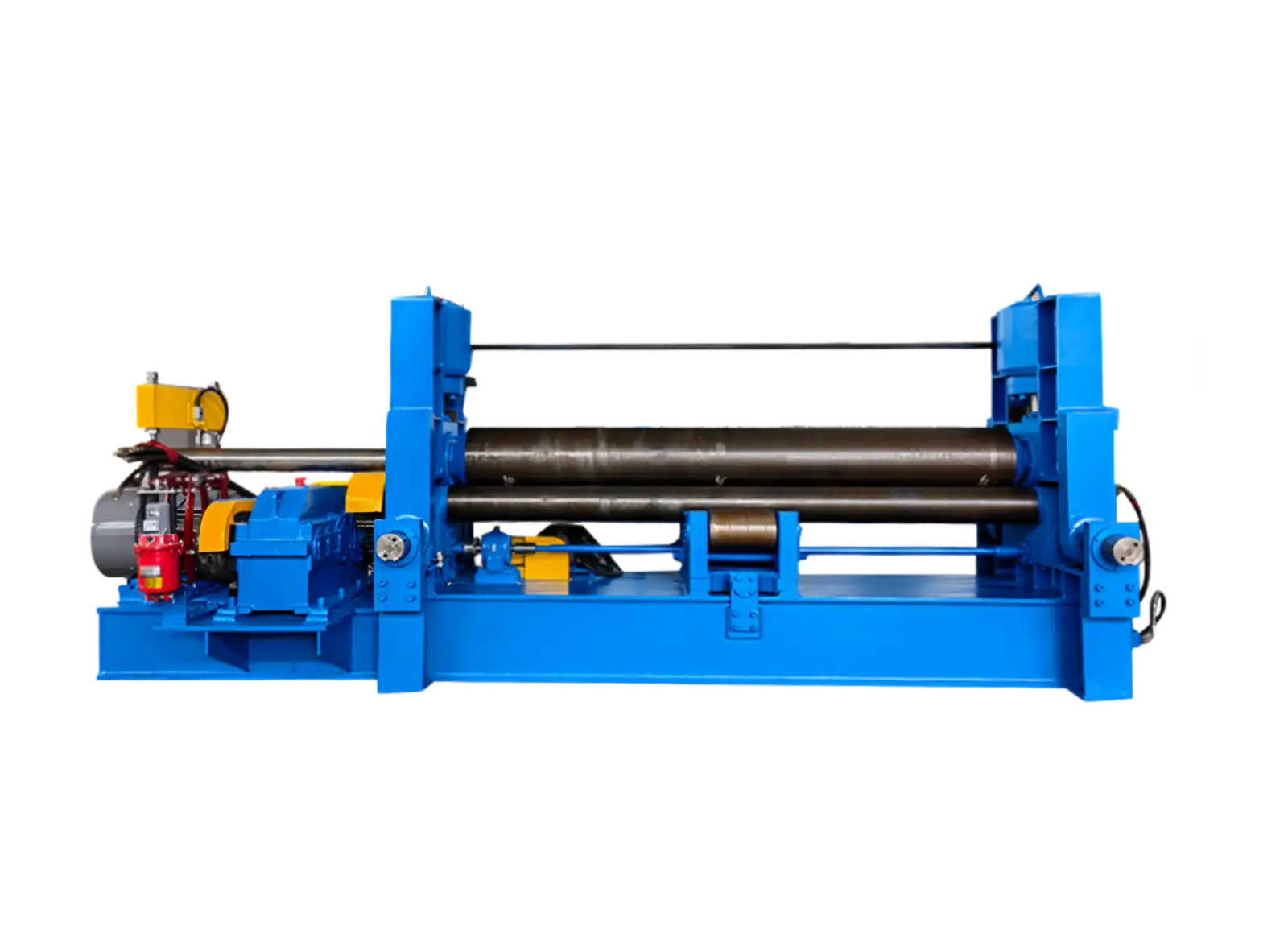

1. What Does “Machine Capacity” Mean?
When suppliers describe a plate roll bending machine, capacity may refer to several different values:
- Maximum rolling thickness: The thickest plate the machine can roll after suitable pre-bending.
- Maximum pre-bending thickness: The thickest plate the machine can pre-bend at the specified width and diameter.
- Maximum working width: The greatest plate width supported by the rolls.
- Minimum rolling diameter: The smallest inside diameter that can be achieved under specified conditions.
- Material reference: The material grade or yield strength used for the capacity rating.
These values must be read together. A machine rated as “20 mm × 3,000 mm” may have a different pre-bending capacity, minimum diameter, or material limitation depending on the manufacturer’s test conditions.
2. The Six Variables Used in Capacity Calculation
2.1 Plate Thickness (S)
Thickness is usually the most influential variable. Bending resistance rises quickly as thickness increases, so a small increase in plate thickness can require a much larger forming force.
Always distinguish between:
- Common production thickness
- Maximum occasional thickness
- Thickness during pre-bending
- Thickness after the plate has already been formed at the ends
2.2 Working Width (B)
Working width is the length of plate engaged by the rolls. A wider plate generally creates a higher total load and may increase roll deflection.
For reliable selection, provide the maximum width rather than only the average width. Also consider whether the plate will be supported across its full width during loading and rolling.
2.3 Material Yield Strength (σᵧ)
Yield strength describes the stress at which the material begins permanent plastic deformation. Higher-yield-strength materials require greater force to form than softer materials of the same thickness and width.
The supplier should know the actual material grade whenever possible. If only a trade name is available, request confirmation of the assumed yield strength before comparing capacities.
2.4 Target Rolling Diameter (D)
The required inside diameter or radius affects the contact geometry and forming force. A smaller diameter is usually more demanding, especially for thick or high-strength plate.
Do not compare two machines using only thickness and width. The same machine may have different capacity limits at different diameters.
2.5 Roll Spacing and Roll Diameter
Roll spacing changes the effective lever arm and load distribution. Roll diameter influences stiffness, contact pressure, minimum diameter, and resistance to local deformation.
These values are normally built into the manufacturer’s capacity calculation. They are still important when comparing machines with similar nominal specifications.
2.6 Pre-Bending Requirement
Pre-bending and ordinary rolling are different operations. Ask for both capacities separately and check the remaining straight-end length after pre-bending.
For pressure vessels, tanks, ship sections, and welded cylinders, poor pre-bending can create additional trimming, correction, and fit-up work.

3. A Simplified Capacity Formula
A simplified model can be used to show the relationship between the main variables:
P=K×σy×B×S2t
Where:
- P = estimated forming force
- K = design and safety factor
- σᵧ = material yield strength
- B = working width
- S = plate thickness
- t = effective roll span or lever-arm dimension
The exact form used by a manufacturer may be different because machine geometry, friction, roll diameter, number of passes, material condition, and bending method all affect the result.
What This Formula Shows
- Increasing S has a strong effect because thickness is squared.
- Increasing B increases the total forming load.
- Increasing σᵧ increases the required force.
- Changing t changes the mechanical leverage and load path.
- The theoretical force is not the same as a safe continuous machine rating.
4. Worked Example: Initial Capacity Estimate
Assume the following preliminary requirement:
- Material: mild steel
- Yield strength: approximately 245 MPa
- Plate thickness: 12 mm
- Working width: 2,500 mm
- Required inside diameter: to be confirmed
- Effective roll-span dimension: 1,000 mm
- Preliminary design factor: 1.25
Using the simplified model:
P=1.25×245×2500×1221000
This produces a preliminary force estimate of approximately 110,250 N, or about 110 kN.
This value is only a starting point for understanding the load relationship. It is not a final machine tonnage recommendation. The manufacturer must still verify the roll arrangement, actual diameter, pre-bending requirement, number of passes, drive torque, hydraulic pressure, frame stiffness, bearing loads, and safety margin.
Why the Example Matters
If the plate thickness increases from 12 mm to 16 mm while other variables remain unchanged, the thickness term changes from 122 to 162. The required force therefore rises much faster than the thickness itself.
If the same 12 mm plate is changed from mild steel to a higher-strength grade, the required force also increases in proportion to the material yield strength.
5. Material Strength Correction
A capacity chart is meaningful only when its reference material is known. Use the following table as a general direction, not as a substitute for a manufacturer verification.
A useful first comparison is to scale the required force approximately with the ratio of the actual yield strength to the reference yield strength:
Fcorrected≈Freference×σy,actualσy,reference
This is still an approximation. Work hardening, plate condition, friction, and the rolling method can change the actual result.
6. Rolling Capacity vs. Pre-Bending Capacity
This is one of the most important points when selecting a plate roll.
Rolling Capacity
Rolling capacity usually describes the machine’s ability to gradually form a plate after the plate ends have been prepared. It may involve multiple passes and a specified minimum diameter.
Pre-Bending Capacity
Pre-bending capacity describes the machine’s ability to bend the leading and trailing edges before the main rolling operation. It is often lower than the rolling capacity.
Questions to Ask
- What is the maximum rolling thickness at the required width and diameter?
- What is the maximum pre-bending thickness at the same conditions?
- What is the remaining straight-end length?
- Is the value based on a three-roll or four-roll process?
- Does the machine need multiple pre-bending passes?
- Can the machine clamp the plate securely to prevent slipping?
For many cylindrical products, a machine with better pre-bending performance may reduce total production cost even if its purchase price is higher.
7. How Machine Type Changes the Capacity Calculation
Symmetrical Three-Roll Machine
A symmetrical three-roll machine can be suitable for general rolling, but its roll geometry may leave longer straight ends and require a separate pre-bending operation. Capacity should be checked for both the rolling sequence and the pre-bending method.
Asymmetrical Three-Roll Machine
An asymmetrical layout can improve edge engagement and simplify pre-bending. It may be useful for smaller-diameter work and applications requiring flexible setup.
Four-Roll Machine
A four-roll machine clamps the plate between the upper and lower rolls while the side rolls form it. This can improve feeding stability, reduce handling, and support efficient pre-bending for repetitive cylindrical work.
The machine type does not eliminate the need for a capacity calculation. It changes the load path, process sequence, and practical production capability.
8. Reading a Manufacturer’s Capacity Chart
Before accepting a capacity table, check the following details:
- Reference material and yield strength
- Plate thickness: rolling or pre-bending value
- Working width
- Minimum rolling diameter
- Number of passes assumed
- Roll diameter and roll spacing
- Whether the value is for a finished cylinder or an initial pass
- Machine drive and hydraulic conditions
- Expected straight-end length
- Safety margin and operating limitations
A clear capacity chart should show the conditions behind the number. If the conditions are not listed, ask the supplier to provide a written technical explanation.
9. Capacity Is More Than Forming Force
A machine may have enough forming force but still be unsuitable for the application. Complete capacity evaluation should include:
- Roll strength and deflection
- Frame rigidity
- Bearing load and service life
- Drive torque and motor power
- Hydraulic pressure and cylinder capacity
- Plate feeding and support conditions
- Roll surface condition
- CNC positioning accuracy
- Safety devices and emergency stopping
The weakest part of the load path can limit the real machine capacity.
10. A Practical Selection Workflow
Use this workflow before requesting a quotation:
Step 1: Prepare the Material Data
List material grade, yield strength, thickness range, width range, and surface requirements.
Step 2: Define the Geometry
Specify inside diameter, radius, cylinder length, cone angle, variable curvature, and acceptable straight-end length.
Step 3: Separate Production and Maximum Values
State the most common production condition separately from the occasional maximum condition. This helps the supplier recommend a practical machine rather than an unnecessarily oversized model.
Step 4: Select the Required Process
Explain whether the machine must only roll, or must also perform pre-bending, cone rolling, multi-pass forming, and repeated program production.
Step 5: Request a Verified Calculation
Ask the manufacturer to confirm rolling capacity, pre-bending capacity, minimum diameter, expected straight-end length, and recommended safety margin using your actual conditions.
Step 6: Arrange a Test or Demonstration
If the workpiece is critical or the material is high strength, provide sample drawings or material for a forming test.
11. Information to Include in an RFQ
Send the following information to the supplier:
- Material grade and yield strength
- Minimum and maximum thickness
- Maximum plate width
- Required inside diameter or radius
- Rolling and pre-bending requirements
- Cylinder, cone, arc, or variable-radius geometry
- Production quantity and cycle expectations
- Desired three-roll or four-roll configuration
- Manual, hydraulic, or CNC control preference
- Available power and workshop space
- Lifting and plate-support conditions
- Installation, training, and after-sales requirements
The more complete the data, the more reliable the machine recommendation will be.
Conclusion
To calculate plate roll bending machine capacity, start with the complete forming requirement rather than a single thickness number. Plate thickness, working width, material yield strength, rolling diameter, roll geometry, and pre-bending requirements all influence the real load.
A simplified formula can help explain the relationship between these variables, but final machine selection must be verified through the manufacturer’s engineering calculation, capacity chart, and—when necessary—a forming test.
The safest buying decision is based on two separate questions: Can the machine roll the plate? and Can it pre-bend the plate to the required geometry? Once these questions are answered with the actual material and workpiece data, you can select a machine with the right balance of capacity, accuracy, productivity, and cost.
[Contact PLSON Engineers for a Capacity Review →]
Related topics: Plate Roll Bending Machine Design, Plate Bending Machine for Shipbuilding, Three-Roll vs. Four-Roll Plate Rolling Machine.
[Talk to a PLSON Engineer →]
📧 Eric@plsonmachine.com
🏭 Haian Industry Park, Jiangsu Province, China