
Four Roll Plate Rolling Machine: Working Principle and Selection
A four roll plate rolling machine is the fastest, most accurate and easiest to operate of the roll benders — and unlike most marketing claims in this industry, this one holds up under inspection. The advantage does not come from better steel or a bigger hydraulic pump. It comes from the roll geometry, which lets the machine clamp the plate at its very edge, pre-bend both ends without removing the workpiece, and keep the sheet under continuous drive from the first pass to the closed seam.
That single geometric fact is what separates a four-roll machine from a three-roll machine. Everything else — the shorter floor space, the one-man operation, the cone capability, the viability of NC and CNC control — follows from it.
The core principle: three points define the circle
All plate rolling is three-point bending. Two contact points hold the plate; a third displaces it. The radius of the resulting curvature is a function of how far that third point pushes relative to the span between the first two.
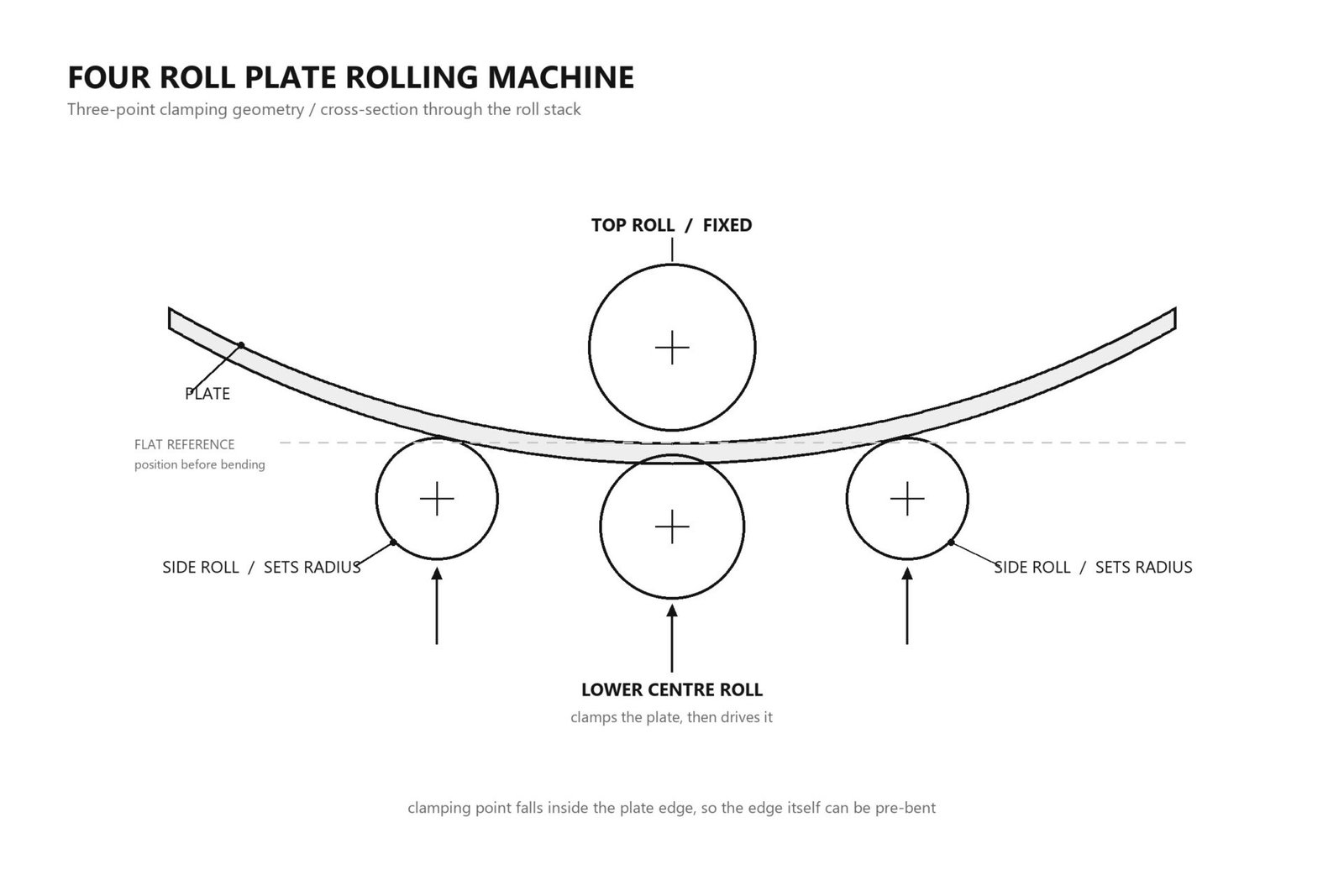
On a four roll machine those three functions are distributed across four rolls:
- Top roll — normally fixed in position, and the reference for the whole geometry.
- Lower centre roll — travels straight up to clamp the plate against the top roll. Once clamped, it also drives.
- Two side rolls — rise along a linear or arcing path and set the curvature radius.
Because the top and lower rolls clamp before either side roll moves, the plate is held between two driven rolls at all times. The side rolls then bend against a sheet that cannot shift. That is the mechanical origin of the accuracy claim, and it is also why the bending force never has to be resisted by gravity or by the operator.
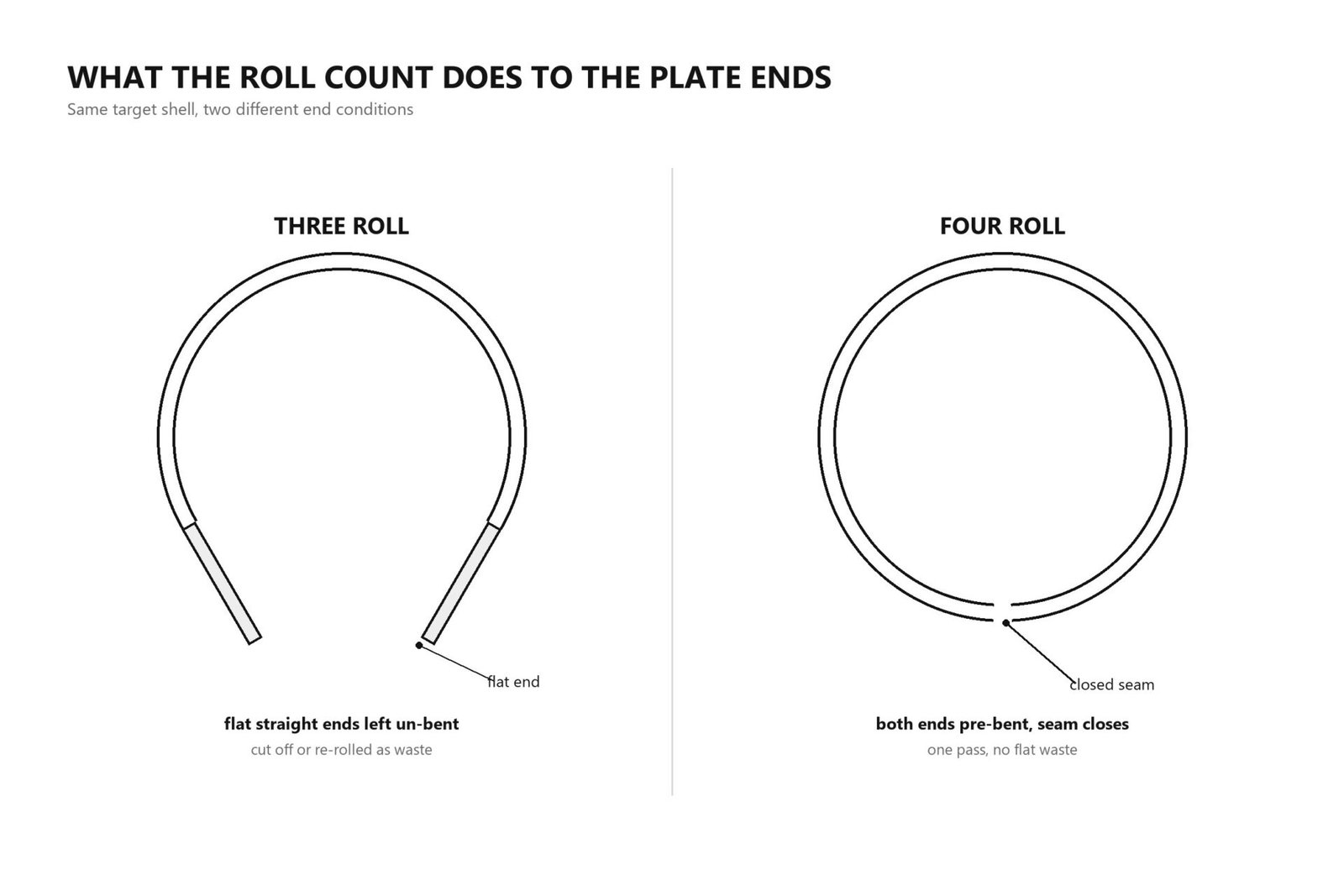
On a three-roll machine the same job is done with three rolls and no separate clamping pair. The plate is positioned by hand or by a lifting device, the rear roll is raised to bend, and the ends of the sheet — the part that sits outside the roll span — stay flat. Those flat ends are the direct edges that later have to be cut off or re-rolled.
Why the clamping point matters more than the roll count
The decisive detail is where the plate is gripped. On a four roll machine the clamping point falls entirely inside the plate edge, which means the edge itself can be pre-bent.
This produces a chain of consequences that buyers usually discover one at a time:
Automatic material alignment. The roll opposite the feed side doubles as a back gauge. The plate is pushed against it and immediately sits square and parallel to the rolls, so levelling the sheet is a simple, single-operator task rather than a two-man wrestling match.
Safe pre-bending. Once the sheet is aligned, the top roll and the lower centre roll clamp it. Pre-bending and rolling then happen with the plate positively held — there is no path by which the sheet can slip out of the rolls under load. On machines without a clamping pair, plate slip is a real hazard, not a theoretical one.
One-sided feed space. Because the plate is fed and formed from one side of the machine only, the aisle space required around the machine is small. In a shop where floor area is the binding constraint, this is often worth more than a specification advantage.
Both ends pre-bent, one pass. After the front edge is pre-bent, the cylinder can be rolled to the required diameter immediately, and the trailing edge is pre-bent afterwards in the same setup. Front and rear bending are both available, and a full cylinder can be formed in a single pass through the machine. There is no need to remove the workpiece, turn it, and re-chuck it.
No plate below the working level. Pre-bending does not require the plate to be tilted down below the working surface. This matters on thick plate, where a tilted overhang is both a handling problem and a safety problem, and it is the reason four-roll machines are preferred for heavy sheet.
Cone rolling: what the side roll tilt actually does
Tapered work is where the roll arrangement shows its flexibility. Tilting the side rolls sets the cone angle, and the lower centre roll can also be tilted while continuing to clamp and drive the plate. Cones up to roughly 30° included angle are practical.
Capacity, however, is not the same as on straight work. As a working rule, cone rolling capacity drops to about one third of nominal cylindrical capacity, and a dedicated cone rolling attachment is normally required. On a 16 mm machine, for example, cone work is realistically limited to around 6 mm — the number is not a marketing limitation, it is what the force balance allows once the contact line becomes a line of varying radius.
Why four rolls is the only architecture that suits NC and CNC
This is the argument that is most often repeated and least often explained.
Effective numerical control requires two things from the machine: that the workpiece position is known, and that the workpiece is driven throughout the cycle. A control system can only command roll positions meaningfully if the plate has not moved relative to the rolls between operations. On a four roll machine the plate is clamped and driven continuously, so roll position maps directly to bend radius, and a stored program reproduces the same part on the next sheet without an operator re-establishing the setup by feel.
On a three-roll machine, the plate is repositioned, the ends are handled separately, and the operator’s judgment sits inside the control loop. You can retrofit a control, but you are automating a process whose reference point keeps moving.
This is why the practical dividing line in the market is not “manual versus CNC” but “three-roll versus four-roll”. If your parts require repeatability, a four-roll machine with an NC or CNC control is the configuration that delivers it.
Accuracy and repeatability in production terms
The control system adjusts roll position and rolling pressure, so wall thickness and final shape are set by parameters rather than by operator skill. Because the clamping geometry repeats exactly, sheet-to-sheet variation is small — the second hundred cylinders match the first.
For a fabricator running batch work, that consistency is the economic case for the machine. Rework on rolled shells is expensive out of proportion to its frequency: a shell that comes out out-of-round has to be cut, re-rolled or scrapped, and it usually takes a whole vessel or duct assembly down with it.
Drive type is a separate question from roll count
A frequent confusion: buyers compare “hydraulic” and “servo” as if that were the same decision as three-roll versus four-roll. It is not.
Roll count decides the geometry — whether the edge can be clamped, whether pre-bending is single-setup, whether NC control is meaningful. Drive type decides how the rolls are moved and how much energy the machine draws while doing it:
- Hydraulic drive uses cylinders for the clamping and side-roll motion. High force per unit of machine size, mature and easy to service, lower purchase price.
- Servo / all-electric drive uses servo motors and screws or a hybrid arrangement. Better positioning resolution, lower idle consumption, quieter operation, no oil to manage — at a higher capital cost.
The sensible sequence is to fix the architecture first, then the drive. A servo-driven three-roll machine is still a three-roll machine; a well-specified hydraulic four-roll machine will still out-produce it on pre-bent, closed-seam work.
What to specify before you buy
Work through these in order — each answer constrains the next.
- Material and thickness range. Not the maximum only, but the range you actually run. Capacity is quoted in mild steel; stainless and high-strength plate reduce it, and the reduction is significant rather than marginal.
- Maximum rolling width and plate length. This sets roll diameter and frame size, and it is the parameter that most often forces a jump to the next model.
- Finished diameter range. Small-diameter work on a large machine is limited by roll interference, not by force. Check the minimum diameter the roll set can physically produce.
- Whether ends must be pre-bent. If your drawings call for a true cylindrical shell with a closed seam, you need edge pre-bending, and that is a four-roll requirement.
- Cone or taper work. If yes, confirm the cone angle, the reduced thickness capacity and whether the cone attachment is included in the quotation. It is usually an option.
- Control level. NC positioning for repeatable single-radius work; CNC with stored programs where you run families of parts or multi-radius profiles.
- Floor space and handling. Confirm the feed-side clearance and how plates will be loaded — overhead crane, vacuum lifter or roller table.
- Service and spares. Roll bearings, hydraulic seals and control components should be available as stock items, not as special orders.
The short version
A four roll plate rolling machine is not a three-roll machine with an extra roll. The fourth roll creates a clamping pair, the clamping pair moves the bend point to the plate edge, and edge clamping is what makes single-setup pre-bending, one-pass cylinder forming, meaningful NC control and compact floor space possible at the same time. If your work involves closed-seam shells, repeatable batches, or heavy plate, that combination is the reason to specify four rolls rather than three.
[Talk to a PLSON Engineer →]
📧 Eric@plsonmachine.com
🏭 Haian Industry Park, Jiangsu Province, China