
Four-Roll Plate Rolling Machine: Cone Adjustment Techniques (Hydraulic & CNC)
Introduction
When rolling conical reducers (cone-shaped fittings) on a four-roll plate rolling machine, the roll adjustment techniques directly determine product quality and production efficiency. In this article, the PLSON editorial team will explore the techniques of using hydraulic cylinders to push roll movement for taper adjustment, and introduce the application of CNC systems in achieving precise taper control.
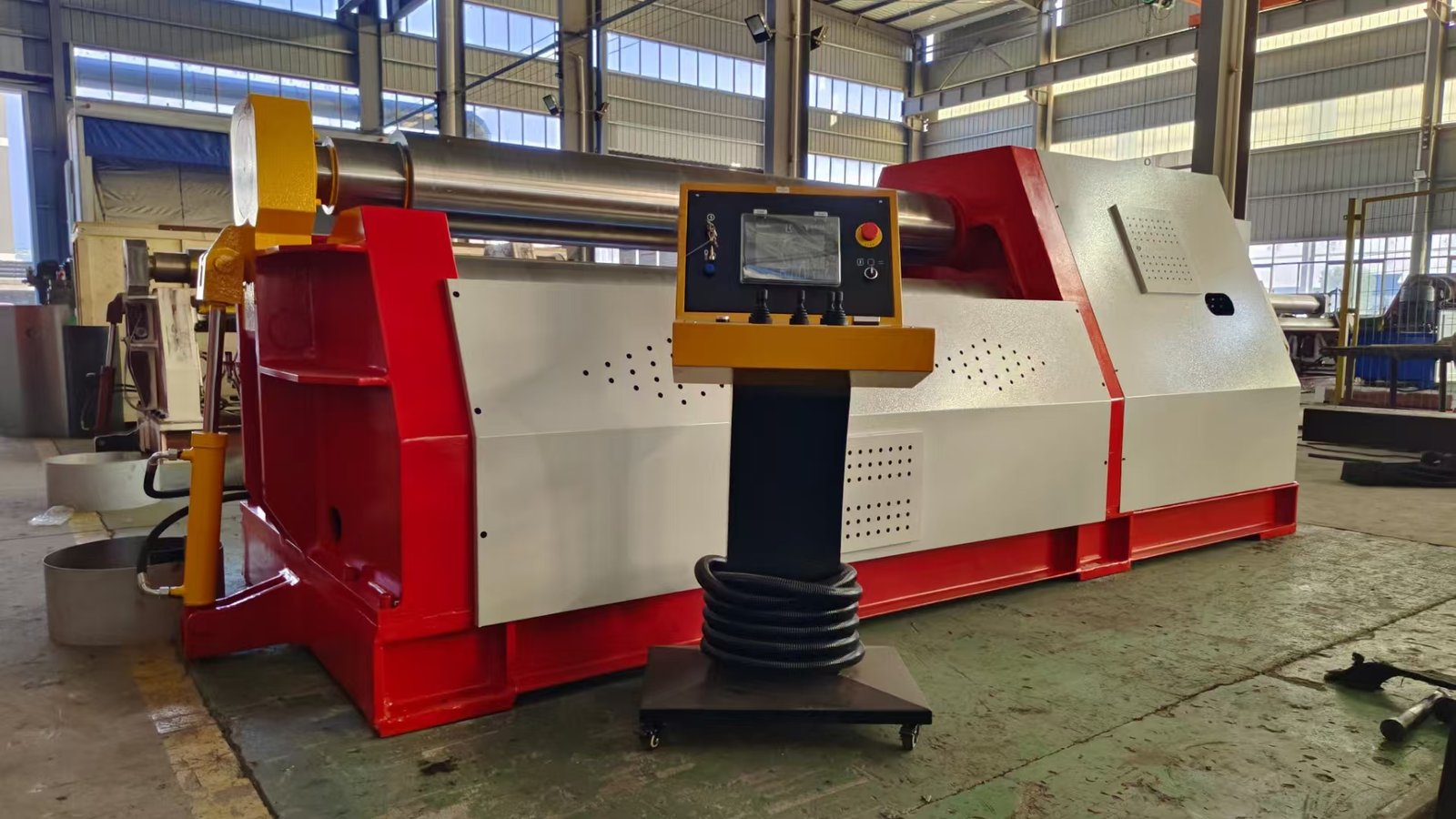
How Roll Adjustment Works on a Four-Roll Plate Rolling Machine
The four-roll plate rolling machine achieves bending and rolling of metal plates through the coordinated action of its four rolls. When rolling conical reducers, the key lies in adjusting the relative positions between the two side rolls (the top roll and the bottom roll) to form the required taper. The hydraulic cylinder serves as the power source, driving the roll movement to accomplish this adjustment.
In actual operation, the stroke of the hydraulic cylinder is typically adjusted by setting limit switches or sensors. These devices monitor the travel distance of the rolls and send a signal to stop the hydraulic cylinder when the preset position is reached. Pressure adjustment, on the other hand, is usually achieved by adjusting the output pressure of the hydraulic pump or installing a pressure reducing valve. By precisely controlling these two parameters, the rolls can be moved to the predetermined position to form the required taper.
Precise Taper Control with CNC Systems
Alternatively, a CNC system can be used to precisely control the position and movement trajectory of the rolls, enabling the rolling of different tapers.
A CNC system typically consists of a computer, a controller, and actuators. When rolling cones on a four-roll plate rolling machine, the CNC system:
- Receives input parameters (such as taper angle, plate thickness, etc.)
- Automatically calculates the roll positions and movement patterns
- Sends commands to the actuators (such as hydraulic cylinders and proportional valves) for adjustment
The entire adjustment process is automated and intelligent, greatly improving production efficiency and product quality.
Key Advantages of the CNC System
| No. | Advantage | Description |
|---|---|---|
| 1 | Easy operation | Parameters are set via programming, requiring no manual intervention during adjustment. |
| 2 | Fast adjustment speed | Automated calculation and execution enable rapid parameter changes between jobs. |
| 3 | High adjustment accuracy | Precise, repeatable control of roll position for consistent taper accuracy. |
| 4 | Low labor intensity | Eliminates manual adjustment work and reduces operator skill requirements. |
| 5 | Data storage & traceability | Records adjustment parameters and results for each run, providing reference data for subsequent production. |
Conclusion
By using hydraulic cylinders to push roll movement and CNC systems to precisely control roll positions, precise taper adjustment and high-efficiency production can be achieved. However, these methods also come with certain costs and technical requirements. Therefore, when choosing a taper adjustment method, factors such as production needs, budget, and technical capability must be considered comprehensively. By continuously optimizing and refining taper adjustment methods, we can provide more efficient, precise, and reliable solutions for the metal processing industry.
[Contact Our Engineers →] 📧 Eric@plsonmachine.com 🏭 Haian Industry Park, Jiangsu Province, China