
CNC Plate Rolling Machine: Working Principle, Advantages and Maintenance
Posted by PLSON Engineering Team
1. Overview
A CNC plate rolling machine is an advanced plate forming machine that combines digital control technology with the conventional plate rolling process. Through its computer control system it can precisely control the parameters of the rolling process — the radius of curvature of the shell, the feed speed of the plate, the rolling pressure, and the position of each roll.
Compared with a conventional plate rolling machine, a CNC machine substantially improves both the precision and the efficiency of plate rolling. For this reason it is widely used in machinery manufacturing, the shipbuilding industry, the petrochemical industry, construction and architectural decoration, and other sectors.
Safety first: A plate rolling machine has powerful nip points between the rolls, and a plate under load can shift, swing or drop. Never reach into the roll area, and never stand in the path of the plate ends while the machine is running. Keep all guards and safety devices in working order and never bypass them. Before any maintenance — cleaning, lubrication, accuracy checking, or work inside the electrical cabinet — stop the machine, isolate the main power, apply lockout/tagout, release the hydraulic pressure, and support the rolls and the plate so they cannot move under gravity. Electrical maintenance should only be carried out by qualified personnel. Only trained and authorized personnel should operate or service the machine.

2. Working Principle
2.1 Mechanical structure
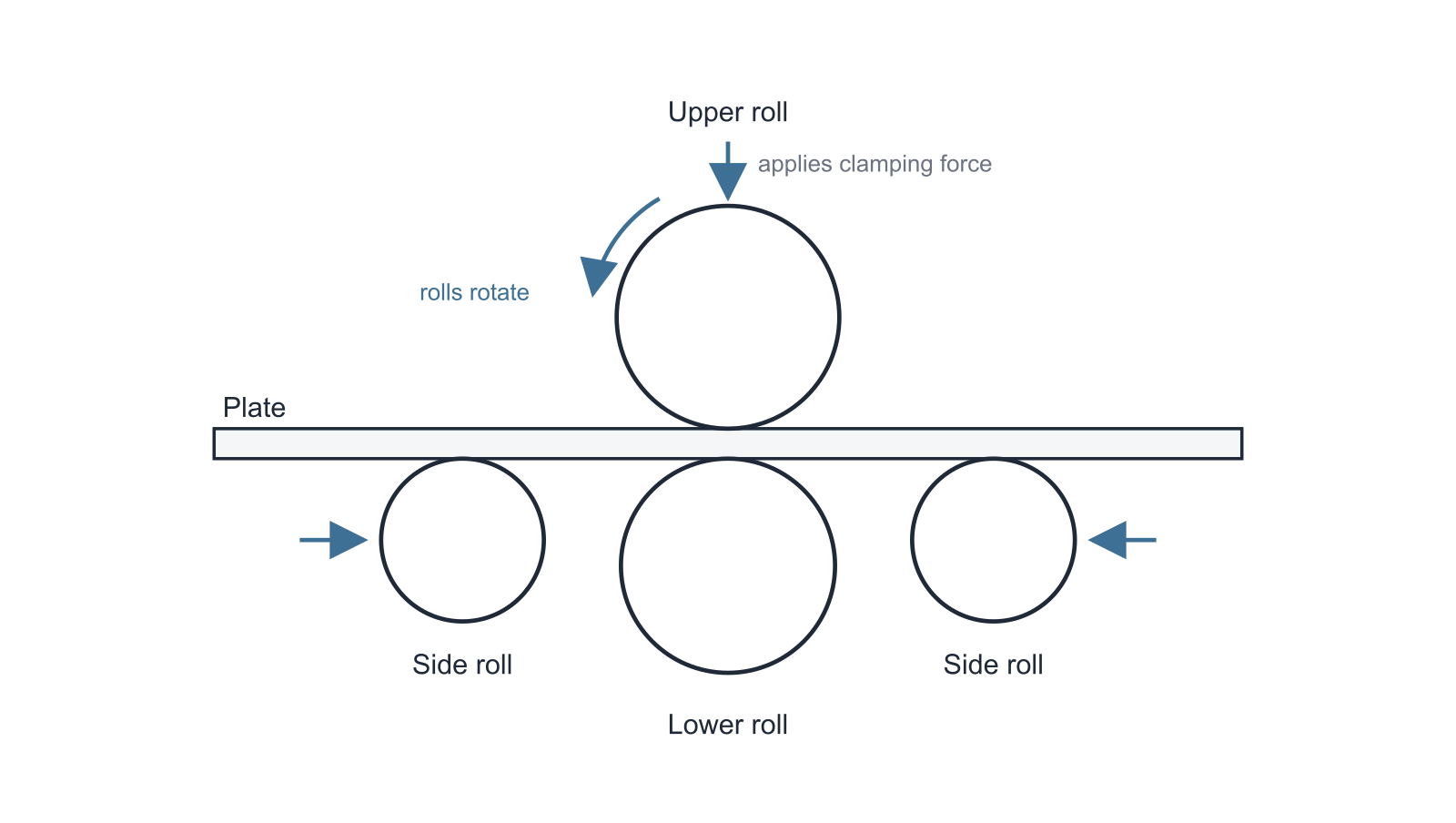
A CNC plate rolling machine consists essentially of three groups of rolls: the upper roll, the lower roll, and the side rolls.
The three groups work together. The plate is gripped between the rolls, driven forward, and progressively bent by the geometry of the roll arrangement until it reaches the required radius.
2.2 How the rolls are driven
It is worth separating two different kinds of motion, because they are produced by different systems.
Which rolls are driven depends on the machine design and size. On smaller machines it is common for one or two rolls to be driven; on larger four roll machines, all rolls are frequently driven so that the plate is gripped and fed without slipping. If you are comparing machines, the drive configuration is one of the specifications worth confirming rather than assuming.
2.3 The CNC system
The operator enters the parameters of the job into the CNC system: plate thickness, width and material, together with the required shell diameter and length. The system analyses and calculates from these inputs, then issues commands to the motors and the hydraulic system to position the upper roll, the lower roll and the side rolls, so that the plate is rolled to the required shape.
A worked example makes this concrete. To roll a shell of smaller diameter, the CNC system moves the upper roll down to increase the pressure on the plate, and at the same time adjusts the speed and position of the lower roll and the side rolls, so that the plate is bent progressively to the required curvature.
What makes the result repeatable is the feedback. The control system compares the measured position of each roll with the commanded position and corrects the difference, rather than assuming that a command has been carried out accurately. Every part then follows the same motion profile as the first one.
3. Features and Advantages
3.1 High precision
Using CNC technology, a plate rolling machine achieves very high rolling accuracy. Positioning accuracy can reach ±0.1 mm, and the roundness error of the rolled shell can be held within ±1 mm. This makes the quality of the rolled product stable and allows it to meet demanding engineering requirements. In the aerospace sector, for example, the rolling of high precision sheet metal parts benefits from the consistency and accuracy a CNC machine provides, which contributes to the quality and performance of the finished assembly.
It is worth understanding why these two figures are different magnitudes, because they measure different things.
A machine can position its axes very accurately and still produce a shell with a larger roundness error, because the material itself contributes to the final shape. The two numbers are complementary, not contradictory, and a buyer comparing specifications should check which one is being quoted.
3.2 High efficiency
A CNC plate rolling machine is highly automated. Loading the plate, rolling it and unloading it can all be carried out under program control. Compared with manual operation on a conventional machine, this substantially shortens processing time and raises productivity.
For repeat batch production of shells of the same specification, the machine can run continuously to a preset program. In that situation output per hour can be three to five times higher than with a conventional machine operated manually. The figure depends heavily on the part, the batch size and the handling equipment around the machine, so it is most meaningful when quoted for a defined repeat job rather than in general.
3.3 Versatility
The machine can roll plate into a range of shapes. It handles the conventional cylindrical shell, and also conical shells and multi-radius forms. Other curved profiles can be produced with the appropriate tooling. By adjusting the parameters in the CNC system, different shapes and sizes can be set up without rebuilding the machine, which meets the varied requirements of industrial production.
In the architectural decoration industry, for example, curved panels for building facades and other special forms are frequently required. A CNC plate rolling machine can produce this type of work, which would be difficult to achieve consistently by manual methods.
3.4 Ease of operation
The operator interface is clear and direct. An operator can learn to use it after a short period of training: parameters and commands are entered on the control panel and the machine carries out the rolling operation. This lowers the technical threshold for operating the machine and reduces the chance of human error in operation.
It is worth adding one qualification. Ease of operation reduces the skill needed to run the machine, but it does not remove the need for understanding. An operator who knows what bottom dead centre, the roll gap and the curvature parameters actually do will detect a wrong setting earlier, and will use the machine’s capability more fully. Programming also needs to be controlled: the parameters that matter should be established and stored deliberately, not adjusted until the part happens to look right.
4. Maintenance
4.1 Regular cleaning
Clean the machine thoroughly at least once a week. Remove dust, oil, and metal chips from the machine surfaces. The surfaces of the upper roll, lower roll and side rolls deserve particular attention, because contamination on the roll surfaces affects the quality of the rolled product directly.
Use a clean cloth and a suitable cleaning agent. Do not use sharp tools to scrape the machine surfaces, as these will scratch the rolls and the machine body. Where roll surface condition affects the finished shell, cleaning is not merely housekeeping — it is part of the process.
4.2 Lubrication
Lubricate each lubrication point at the intervals given in the machine manual. As a general guide:
- The bearing positions of the upper roll, the lower roll and the side rolls should be greased every two to three months.
- The hydraulic oil should be changed every six months.
Good lubrication reduces wear on machine components, extends service life, and helps the machine run smoothly. Two practical points: use the lubricant grade specified for the machine rather than a general-purpose substitute, and check the condition of the oil as well as its age. If the oil has darkened, contains water, or shows metal particles, the interval should be shortened rather than extended — the cause is worth investigating.
4.3 Accuracy checking and adjustment
Check the accuracy of the machine monthly. This includes measuring the parallelism of the upper and lower rolls and checking the positioning accuracy of the CNC system.
If a deviation exceeds the specified tolerance, correct it promptly — either by adjusting the mechanical structure of the machine or by recalibrating the CNC parameters, so that the machine continues to work to high accuracy. Two notes on this. First, measure against a record in a machine log, because accuracy problems are far easier to detect as a trend than as a single reading. Second, keep the machine’s record of its own measurements separate from the acceptance criteria: the trend is what tells you whether something is starting to wear.
4.4 Electrical system maintenance
Check the electrical connections regularly. Confirm that cables and wires are undamaged and that no terminals are loose. Inspect the components inside the control cabinet — contactors, relays and similar parts — for signs of overheating, arcing or other abnormalities.
Clean dust out of the electrical system comprehensively every six months. Dust accumulation affects the performance and the service life of electrical components, and in a workshop environment it also increases the risk of a short circuit. Always isolate the power before opening the control cabinet.
4.5 Maintenance schedule at a glance
Intervals in this table follow the manufacturer’s manual and the working environment. In a heavy dust environment, or where the machine runs multiple shifts, the cleaning and inspection intervals should be shortened.
5. Conclusion
A CNC plate rolling machine brings digital control to a traditional forming process. The mechanical structure — upper roll, lower roll and side rolls — has not changed in principle, but the way those rolls are positioned and controlled has.
The result is a machine that offers high precision, with positioning accuracy of ±0.1 mm and shell roundness held within ±1 mm; high efficiency in repeat batch production; the versatility to roll cylindrical, conical and other curved forms; and an operator interface that can be learned quickly.
What sustains those advantages over years of production is maintenance: weekly cleaning of the machine and the roll surfaces, timely lubrication of the roll bearings, a regular change of hydraulic oil, monthly measurement of accuracy, and periodic attention to the electrical system. A CNC machine that is not maintained will drift out of tolerance just as surely as a manually operated one — it will simply do so more quietly.
If you are selecting a CNC plate rolling machine, or want to know which parameters and specifications matter for your particular shells, contact our engineering team with your material, plate thickness, and the diameters and lengths you need to roll.
Contact the PLSON Engineering Team for CNC plate rolling machine specifications, tooling and technical support.
[Talk to a PLSON Engineer →]
📧 Eric@plsonmachine.com
🏭 Haian Industry Park, Jiangsu Province, China