
CNC Panel Bender vs Press Brake: Forming Method Explained
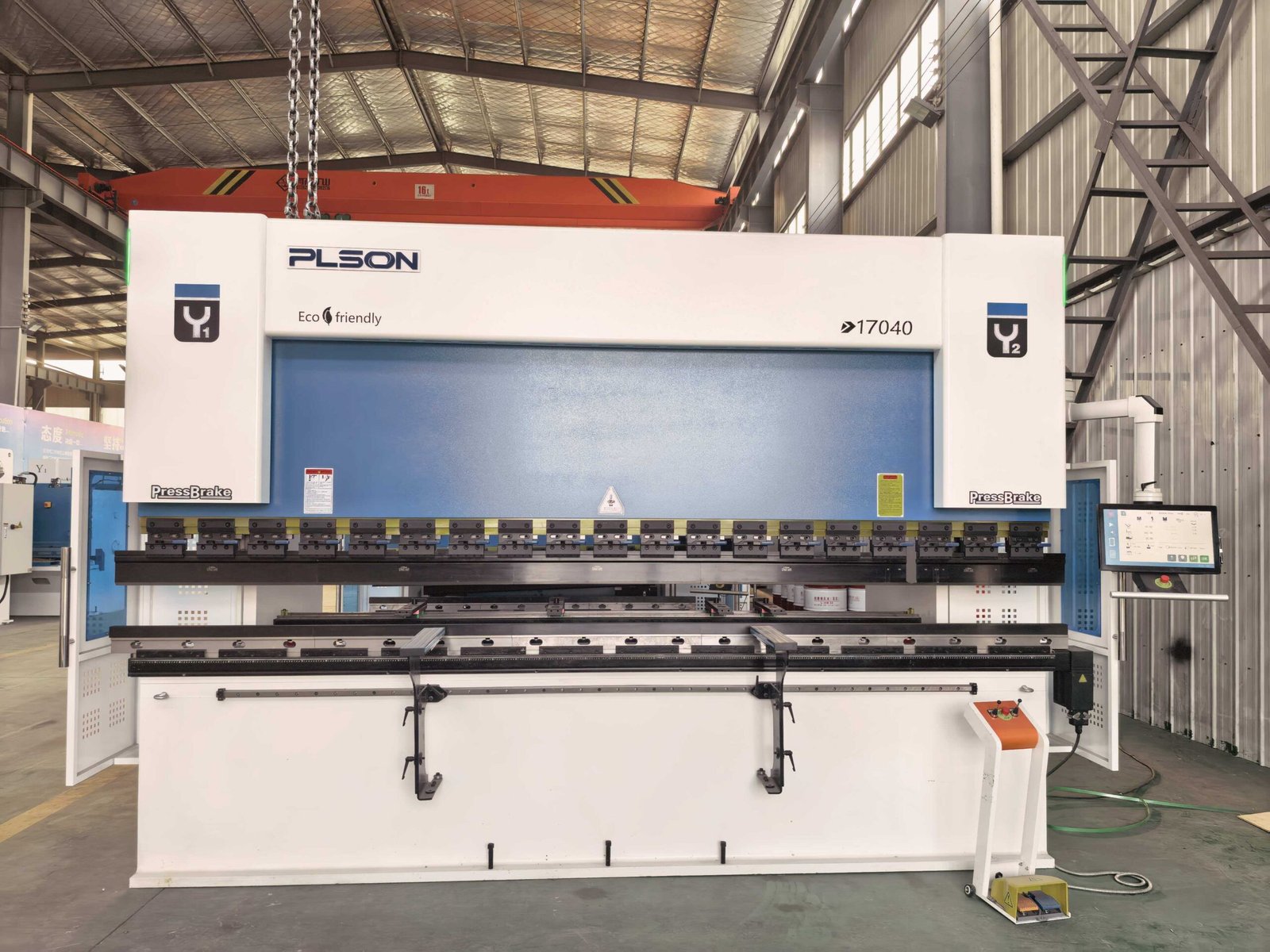
A press brake and a CNC panel bender both turn flat sheet into a folded part, and they do it by opposite means. A press brake drives a punch down into a V-die, and the sheet is drawn over both shoulders of the die opening. A panel bender — also called a panel folding machine — holds the blank still, clamps it, and swings a folding beam to wrap the material around a single die edge.
That one difference runs through everything downstream: where the bend radius comes from, how the flat pattern is calculated, which special profiles can be formed, and how the machine is programmed.
1. Two forming principles
1.1 Press brake: vertical ram, V-die, forming on both sides
On a press brake the ram travels vertically. The punch enters the V-opening of the lower die and the sheet is bent over both die shoulders at once. It is a symmetric, two-sided forming operation: material on both sides of the bend line deforms, and the inside radius is a function of the V-opening, the punch tip radius and the material.
The whole bend line is loaded simultaneously, which is why tonnage scales with thickness squared and with bend length.
1.2 Panel bender: clamp plus folding beam, forming on one side
On a panel bender the blank is located against a gauge and held by a clamping mechanism — a clamp bar pressing the sheet against the clamping tool. A folding beam then swings up or down and pushes the projecting edge of the sheet around the edge of the folding die.
So the bend is single-sided. Only the material outside the clamp line deforms, and the radius is set by the folding die geometry and the gap between the folding blade and the die — not by a V-opening.
Two practical consequences follow:
- The sheet does not have to be lifted, turned and re-seated between bends. The clamp can hold it while the beam folds in different directions.
- Feeding, clamping and folding can be interlocked on the CNC, which is what allows multi-step profiles to be formed without re-fixturing the part.
1.3 Where the numbers come from
2. The gap multiple takes the place of the V-opening
On a press brake, choosing tooling means choosing a V-die: for mild steel the opening is commonly 6–8 × sheet thickness, and that one number sets both the force required and the shortest flange the die can form (how that relationship works). On a panel bender the equivalent decision is the gap multiple — the fold radius expressed as a multiple of sheet thickness.
It is not one number. The multiple is a function of the material — grade, thickness, and whether the sheet is carbon steel, stainless or aluminium — and it also governs what the machine can form on that job. Pick outside the range and the bend is either beyond the machine’s capability or outside the radius the drawing asks for.
For the panel bender class this parameter data covers 0.2–4.0 mm carbon steel, stainless steel and aluminium. The values are derived from finite element analysis combined with measured production data, then stored in the CNC as a material table. The operator selects material and thickness, and the control applies the matching multiple automatically, with no manual intervention on the parameter itself.
The practical effect: radius consistency stops depending on whether the operator remembers the right rule of thumb.
3. Flat pattern: why the coefficient is not the same
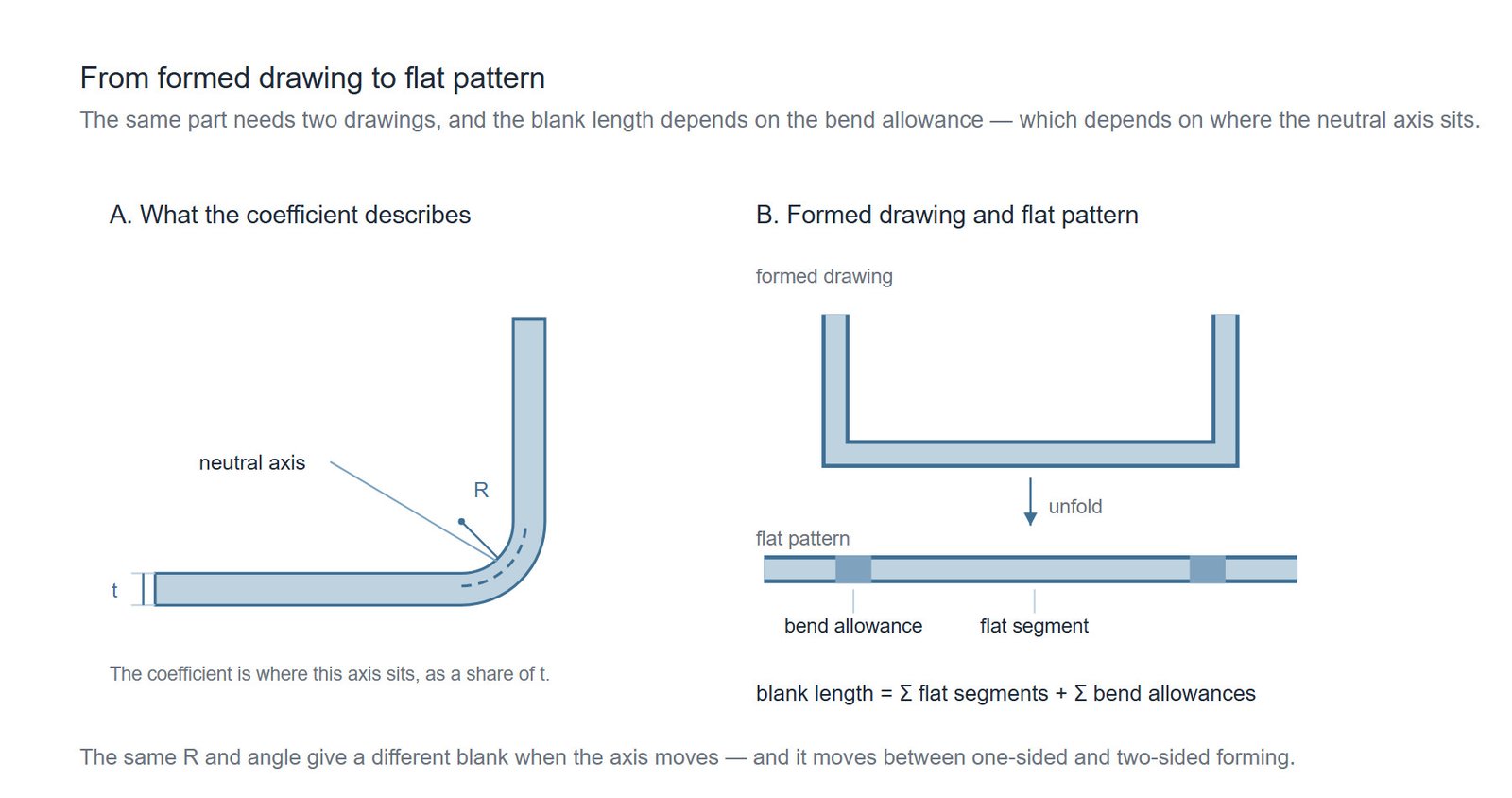
Every folded part needs two drawings — the formed part and the flat blank. The link between them is the flat pattern coefficient.
Because the panel bender forms on one side and the press brake forms on both, the material either side of the bend line is not strained the same way. The neutral axis does not sit in the same place, so the same nominal radius and angle produce a different developed length (Figure 1). Apply a press-brake coefficient to a panel-bender job and the blank comes out short or long.
In production this shows up quickly. Customers often supply the formed drawing only — finished dimensions, no blank size. Without a correct coefficient the blank has to be cut, trial-formed, measured and corrected, sometimes more than once, and that loop is where a small batch loses its margin.
3.1 Two programming routes, one result
The coefficient is now accurate enough to work in the other direction: from the formed dimensions you can derive a flat pattern that cuts correctly the first time.
The CNC also accepts both programming routes — programming by formed dimension and programming by bend line — and either produces the same part. The shop uses whichever matches the drawing it was given, rather than redrawing to suit the machine.
4. What the forming method makes possible
4.1 Radius and arc forming
A press brake forms an arc in one of two ways: a dedicated radius tool, which is expensive and only fits one job, or a small-step feed, which saves the tooling cost but is slow to set up and hard to hold — and if a robot is involved, the teaching time is significant either way.
A panel bender forms the arc from the program. Feeding and folding are coordinated in small increments, and arc process compensation is built into the CNC, so the operator enters the characteristic dimensions and the machine produces the required radius. No radius tool, and no tool change between radii.
4.2 Flattening (dead-edge hemming)
Electrical cabinets and door panels are usually given a flattened hem — a dead edge in shop language — to remove the sharp edge and stop the panel distorting. The panel bender integrates the flattening cycle and simplifies the programming parameters, with the parameter set extended per industry where the required result differs. Different flattening directions are supported.
4.3 Special flattening
Two variants extend the basic cycle:
- Closed flattening. The hem is closed to a defined opening height, so the part can meet different opening requirements instead of being crushed fully flat.
- Folding-beam flattening. The folding beam is used to work around the section of the part that would otherwise foul the clamping tool. The difficulty is calculating the clearance parameters from the shape that has already been formed — which is precisely the case a press brake finds hard.
4.4 Custom profiles
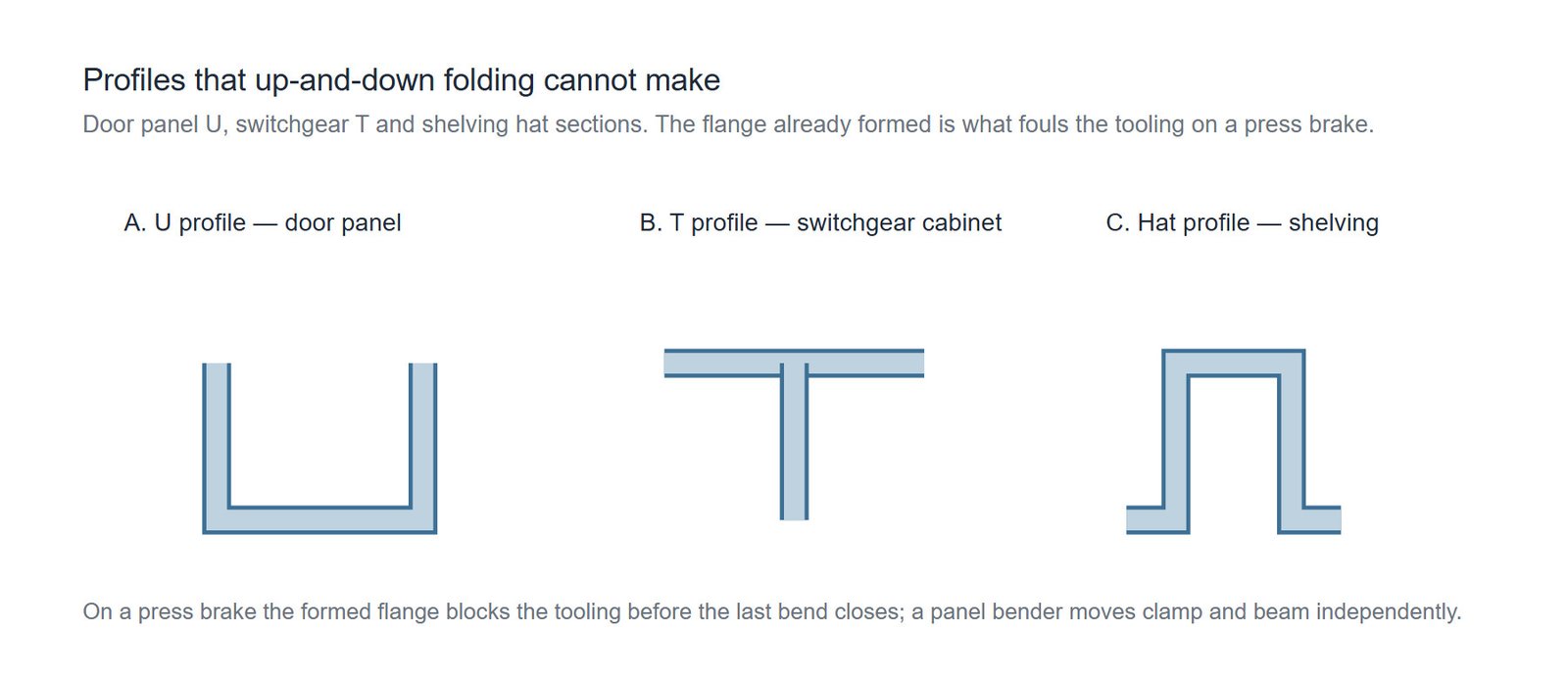
Door panels need a U profile. Switchgear cabinets need a T. Shelving needs a hat section (Figure 2). None of these can be made by simple up-and-down folding, and on a press brake the flange already formed tends to be in the way before the last bend is complete.
Because the clamp and the folding beam are separately controlled axes, the machine can be programmed to keep the formed section clear of the tooling and produce these profiles in one accurate sequence. Two features make that usable in a real shop:
- Single-axis motion. Individual axes can be moved independently, so the operator can step around an interference zone without rewriting the whole cycle.
- Custom process interface. For standardised profiles with clear features, the operator enters the formed dimensions only and the CNC generates the motion sequence.
4.5 Where the constraint actually sits
In most cases the limit is not the angle itself, but the geometry of the part relative to the tooling at the moment of forming. A panel bender resolves that in software — by moving one axis out of the way — rather than in hardware, which is why it can produce shapes that would otherwise need a special tool.
5. When dimensional or angle accuracy drifts
Three checks, in the order worth doing them:
- Blank consistency. A panel bender is a batch machine and it assumes the blanks are interchangeable. If incoming blanks vary, decide which dimensions matter: locate on the most stable edge, hold the critical formed dimensions, and accept a wider tolerance on the secondary ones.
- Machine condition. Rust and dust on the clamping and folding tools show up as angle error. Machines running in harsh environments need the maintenance schedule actually followed, not deferred.
- Interference during rotation. If the formed dimensions at the two ends of a bend differ widely and rotation compensation will not correct it, check whether the sheet is fouling something as it rotates into position. Clear the interference, then confirm the clamp bar is actually clamping the sheet.
6. Which machine fits the part
The two are not substitutes. A press brake forms a single bend in any orientation and covers a much wider thickness range. A panel bender is built for thin-to-mid sheet — 0.2–4.0 mm in this class — where the part carries several flanges, needs a repeatable radius without tooling changes, or needs a flattening operation that a V-die cannot produce.
The decision usually comes down to the part drawing rather than the price list: count the flanges, look at the opening heights, and check whether any of them would trap the part against the tooling before the last bend is complete.
[Contact PLSON Engineers →]
📧 Eric@plsonmachine.com
🏭 Haian Industry Park, Jiangsu Province, China